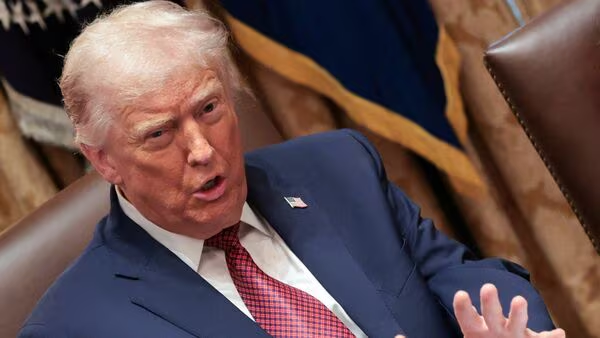
“When Trump’s Indian rice tariff global markets listen—and India’s rice exporters brace for impact.”
On December 8, 2025, in a development that could escalate trade tensions between two of the world’s largest economies, New Delhi and Washington, former U.S. President Donald Trump issued a strong warning about imposing fresh tariffs on Indian rice imports. His remarks, delivered during an extensive policy discussion with American agricultural representatives at the White House, reignited concerns about the future of India–U.S. trade relations.
The comments, coming at a time when global food supply chains are already strained, immediately triggered reactions across international markets, diplomatic circles, and India’s agricultural sector. trade tensions between New Delhi and Washington, former U.S. President Donald Trump has signaled that his administration may impose fresh tariffs on Indian rice imports, claiming that India is “dumping cheap rice” into the American market.
The comments were made during a high‑level meeting with U.S. farm representatives, where Trump also announced a massive aid package for American farmers struggling with falling prices.
This statement has already rattled Indian markets, caused a dip in rice-exporter stocks, and triggered concerns across India’s agricultural and export sectors.
What Exactly Did Trump Say?
During a recent interaction with U.S. farmers at the White House, Trump questioned why India was “allowed” to export cheap rice into the U.S. He suggested that Indian exporters were hurting American growers and that tariffs could be the next step to “take care of the problem.”
He stated that: Trump Indian rice tariff
- India “should not be dumping rice” into the U.S. market.
- The U.S. may impose new duties on both basmati and non‑basmati Indian rice.
- Tariffs could be strengthened as part of a broader effort to protect U.S. farmers.
The remarks echo Trump’s earlier hardline trade approach, which famously included tariff hikes on steel, aluminum, and Chinese goods during his presidency.
Why Is the U.S. Targeting Indian Rice?
American farmers have raised concerns over increasing Indian rice imports, arguing that prices are falling due to cheaper Indian varieties. U.S. farm groups claim the situation is affecting:
- Local market prices
- Profit margins for domestic growers
- Long‑term sustainability of U.S. rice farming
Trump’s statements came while he announced a $12 billion aid package aimed at supporting American farmers under stress.
Market Reaction in India: Stocks Fall Up to 10%
The immediate impact of Trump’s remarks was felt on Dalal Street.
Major rice-exporter stocks witnessed sharp declines:
- KRBL Limited
- LT Foods
- Chaman Lal Setia
- GRM Overseas
Some stocks corrected by 6–10% intraday, reflecting fears of losing a key export market.
India exported over $5.5 billion worth of rice in the last financial year, making it the world’s largest rice exporter.
How Big Is the U.S. Market for India’s Rice?
Though not the largest destination, the U.S. remains a significant buyer of:
- Basmati rice
- Organic and specialty rice categories
A new tariff structure would: Trump’s Indian rice tariff
- Raise export costs
- Reduce competitiveness for Indian brands
- Potentially shift orders to other countries like Thailand or Vietnam
Possible Economic Impact on India: Trump Indian rice tariff
Exporters Will Take a Hit
Higher tariffs mean Indian companies may lose pricing advantage. Exporters may need to:
- Rework global contracts
- Absorb part of the tariff burden
- Shift their market focus
Farmers May Face Price Pressure: Trump’s Indian rice tariff
Reduced export demand can cause:
- Drop in basmati procurement rates
- Greater pressure on states like Punjab, Haryana, and Western UP wh
- ich rely on basmati exports
Global Rice Prices May Rise: Trump’s Indian rice tariff
Any disruption involving the world’s largest rice exporter (India) can push global prices upward, affecting import-dependent regions in the Middle East and Africa.
Geopolitical Angle: Is This the Start of a New Trade Flashpoint?
Trump’s Indian rice tariff comments come at a sensitive time:
- India and the U.S. are engaged in ongoing trade talks
- Both nations are attempting to balance economic cooperation with domestic political pressures
If new tariffs materialize, India may respond via:
- Diplomatic channels
- WTO consultations
- Counter‑measures on American goods (if the situation escalates)
What Happens Next?
The U.S. administration is expected to:
- Conduct an internal review of Indian rice import patterns
- Consult domestic farm lobbies
- Possibly announce preliminary tariff guidelines
India, on the other hand, might: Trump’s Indian rice tariff
- Seek exemptions for basmati rice
- Present data to counter the “dumping” allegations
- Prepare exporters for potential disruptions
Conclusion: Trump’s Indian rice tariff
Trump’s Indian rice tariff of fresh U.S. tariffs on Indian rice imports is more than a political soundbite—it could reshape agricultural trade flows between both nations. While the U.S. aims to protect domestic farmers, the move could hurt Indian exporters, destabilise global rice markets, and trigger a new trade confrontation.
As Washington prepares to make its next move, New Delhi is expected to negotiate aggressively to protect India’s rice export ecosystem, which supports millions of farmers and workers.
FOR MORE BLOGS – beyondthepunchlines.com

Author: Team BTP

 Add to favorites