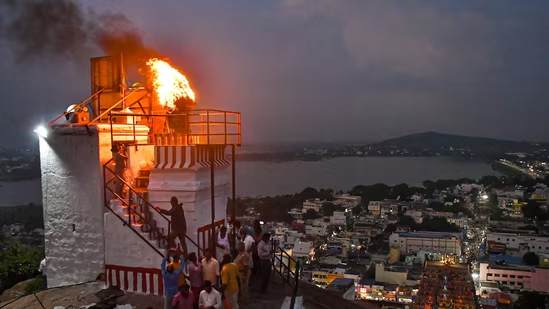
Court upholds tradition: Thirupparankundram lamp lighting shines atop the hill
On 4 December 2025, in a significant affirmation of religious rights, the Madras High Court has upheld an earlier order that allows devotees to light the traditional Karthigai Deepam lamp at the Thirupparankundram hill summit. The ruling brings clarity to a long-standing dispute involving temple customs, property rights, and administrative intervention.
Historical and Legal Context
Thirupparankundram lamp lighting, home to the revered Arulmigu Subramania Swamy Temple, is considered one of the six abodes (Arupadai Veedu) of Lord Murugan. For generations, the lighting of a ceremonial lamp atop the Deepathoon stone pillar during Karthigai Deepam has been an essential religious tradition.
A 1923 civil court decree, later upheld by the Privy Council, clearly demarcated temple-owned land on the hill. According to this decree, the Deepathoon area belongs to the devasthanam (temple administration), and not to the adjacent dargah. This historic judgment formed the foundation for the High Court’s recent order.
Court’s Observations and Decision
The Madras High Court reiterated that the traditional lamp lighting ritual does not infringe on the rights of any other religious group, as the location legally falls under temple jurisdiction. The Court criticized repeated administrative attempts to block devotees from performing the ritual, calling such actions a “wilful disregard” of judicial directives.
The Court also took note of the state’s argument regarding potential law-and-order issues but held that such concerns cannot override well-established religious and property rights. It emphasized that the government has a duty to implement court orders without delay.
State’s Response and Contempt Proceedings
Despite the Court’s clear directive, the state authorities initially restricted access to the hill summit by imposing prohibitory measures. This led to contempt petitions being filed against the administration for non-compliance.
In response, the High Court permitted devotees to light the lamp with adequate police protection, further strengthening the stance that religious customs backed by legal rights must be upheld.
Public and Political Reactions
The verdict drew mixed reactions across Tamil Nadu. Devotees and Hindu organizations welcomed the decision as a victory for tradition and religious freedom. On the other hand, political parties expressed varying views, with some raising concerns about communal sensitivities in the region.
Nevertheless, the Court’s judgment stressed that maintaining law and order is the responsibility of the state, while simultaneously ensuring that legitimate religious practices are not hindered.
Broader Implications: Thirupparankundram lamp lighting
The case sets a precedent for how courts may handle disputes involving overlapping religious spaces and long-practiced customs. It reinforces that judicially established property rights and ancient traditions cannot be set aside due to administrative hesitations.
The ruling also underscores the importance of periodic assertion of temple rights to prevent possible encroachments or misinterpretations in the future.
Conclusion: Thirupparankundram lamp lighting
The Madras High Court’s decision to uphold the lamp-lighting tradition at the Thirupparankundram lamp lighting summit is more than a legal victory—it is a reaffirmation of cultural heritage and the judiciary’s commitment to preserving ancient customs. As devotees continue their age-old ritual atop the sacred hill, the ruling stands as a reminder that faith and law can coexist when backed by clarity, history, and respect for tradition.
FOR MORE BLOGS – beyondthepunchlines.com

Author: Team BTP

 Add to favorites