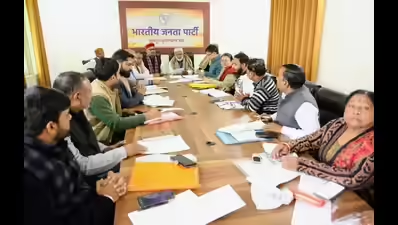
SIR drive India: Voter roll deadlines extended in some states, but Bengal stays on schedule — a crucial move ahead of upcoming elections.
On December 11, 2025, the Election Commission of India (ECI) announced that the Special Intensive Revision (SIR) of electoral rolls would see an extended deadline in six states and one Union Territory to ensure more accurate voter lists ahead of upcoming elections. However, West Bengal was not granted any extension, meaning its SIR schedule remains unchanged.
This decision has sparked debate among political parties, voters, and civil society groups about fairness, administrative capacity, and voter accessibility. The SIR drive India, a cornerstone of India’s electoral preparedness, is vital for ensuring that every eligible citizen can exercise their franchise without facing hurdles or omissions.
What Is the SIR Drive?
The SIR drive India is an extensive electoral exercise conducted by the Election Commission to update, correct, and clean electoral rolls. The process is carried out through several steps:
- House-to-house verification by Booth Level Officers (BLOs) to confirm voter identities and eliminate duplicates.
- Digitisation of voter forms to modernize and centralize the electoral database.
- Removal of ineligible entries, such as deceased persons or those who have shifted constituencies.
- Addition of newly eligible voters, especially citizens who have turned 18 since the last update.
This process is crucial to maintain the integrity of elections and to prevent any form of electoral fraud. It also helps political parties, candidates, and voters plan for the upcoming elections with accurate and verified information.
Which States Get Extensions?
The Election Commission extended the SIR deadlines for the following six regions after assessing progress and administrative challenges:
- Tamil Nadu
- Gujarat
- Madhya Pradesh
- Chhattisgarh
- Uttar Pradesh
- Andaman and Nicobar Islands
The extensions are designed to ensure BLOs can complete their house visits efficiently, digitize forms properly, and address all claims and objections. This step also accounts for logistical challenges, seasonal migration, and administrative delays that may hinder timely completion.
Why No Extension for West Bengal?
In contrast, West Bengal’s SIR deadlines remain unchanged. Officials assert that the state has maintained pace with the revision process and does not require additional time. However, political leaders from opposition parties argue that West Bengal faces unique difficulties, including high migration rates, complex urban voter mapping, and logistical challenges in remote areas. These leaders insist that a uniform extension across all states would ensure fairness and equal opportunity for voters to register and verify their information.
Ground Realities for Voters
For voters in West Bengal, the SIR deadline ending on December 11, 2025, carries significant implications. Tens of lakhs of uncollected or unverified forms are reportedly still pending. Any omissions could result in voters being excluded from the draft electoral rolls, impacting their ability to participate in upcoming elections. Voters are encouraged to actively check their status, submit forms where necessary, and report any discrepancies before the deadline to avoid disenfranchisement.
Political and Administrative Reactions
The decision has triggered a spectrum of responses:
- Chief Electoral Officers in extended states welcomed the move as necessary for ensuring accurate rolls.
- Opposition parties in West Bengal criticised the EC’s decision as inconsistent and unfair.
- Civil society organizations highlighted the pressure on BLOs and the need for secure, efficient execution of the SIR drive.
- The Supreme Court of India has cautioned authorities about potential threats and intimidation of BLOs, emphasizing the importance of orderly conduct and voter protection during the process.
Why This Matters: SIR drive India
The SIR drive is particularly important given the upcoming state elections in early 2026, including West Bengal, Tamil Nadu, Kerala, Assam, and Puducherry. Accurate and verified electoral rolls are crucial for the legitimacy of elections, the fairness of political contests, and voter confidence. The extension for some states versus strict adherence in others raises questions about administrative uniformity and political implications. Any discrepancies or delays can have far-reaching consequences for the democratic process.
Potential Challenges Ahead: SIR drive IndiaSIR drive India
As the SIR process concludes, authorities must address several challenges:
- Ensuring that last-minute claims and corrections are processed efficiently.
- Mitigating the risk of disenfranchisement due to incomplete or inaccurate rolls.
- Balancing political pressures with the need for administrative efficiency.
- Maintaining the security and safety of BLOs during door-to-door verification.
Conclusion: SIR drive India
The Election Commission’s decision to extend SIR deadlines in six states, while keeping West Bengal on schedule, underscores the complex balancing act between administrative efficiency and electoral fairness.
As the 2026 elections approach, the SIR drive India process will remain under close scrutiny by political parties, civil society, and voters. Accurate voter rolls are not only a procedural requirement but a fundamental pillar of India’s democracy, ensuring that every eligible citizen can exercise their right to vote and that elections are conducted fairly and transparently.
FOR MORE BLOGS – beyondthepunchlines.com

Author: Team BTP

 Add to favorites