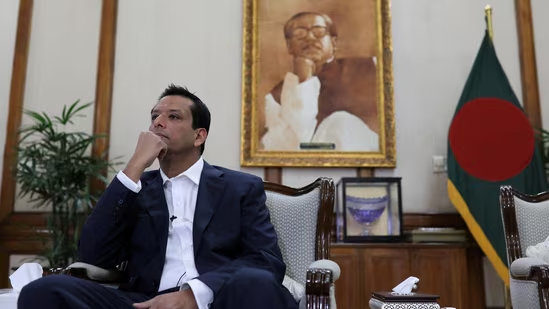
A political storm brews as Sajeeb Wazed warns of unrest, predicts a death sentence, and reveals why Sheikh Hasina is safer across the border than in the nation she once led.
A Nation Awaits a Verdict — And a Warning Rings Loud
On November 16, 2025, Bangladesh stood at a critical crossroads as the much-anticipated verdict involving former Prime Minister Sheikh Hasina approached. But the political atmosphere turned far more volatile after her son, Sajeeb Wazed, issued a dramatic warning: if the ban on the Awami League remains and the verdict goes against Hasina, the country could erupt in large-scale violence.
Wazed’s statements aren’t subtle. They are direct, emotional, and charged with political force — and they come at a time when Bangladesh is already struggling with unrest, crackdowns, and divisions deeper than ever before.
‘She’s Safe in India’: A Statement Loaded With Implications
Perhaps the most significant revelation is Wazed’s claim that Sheikh Hasina is “safe in India”, where she is reportedly receiving full security and treatment akin to that of a head of state. This is not just a personal update — it is a geopolitical message.
- It signals India’s continued support for Hasina.
- It hints at friction between the interim government and New Delhi.
- And most importantly, it limits Bangladesh’s ability to act against her.
Wazed also described his mother’s mental state as “upset, angry, outraged”, reflecting the emotional turbulence behind the political battle.
Prediction of a Death Sentence — And the Firestorm It Could Ignite
According to Wazed, the verdict is all but decided. He believes the court will not only convict Hasina in absentia but may even sentence her to death. This is an extreme claim — and it raises the temperature of an already incendiary political climate.
If this prediction comes true, it could: Sajeeb Wazed
- Trigger widespread protests across major cities.
- Reignite partisan tensions between Awami League loyalists and state forces.
- Invite international scrutiny and diplomatic intervention.
- Push Bangladesh into a period of prolonged instability.
For Wazed, this is not just a legal battle — it is a fight for his mother’s political legacy, and perhaps her life.
The Violence Warning: What Wazed Really Means
Wazed’s most explosive statement was simple but powerful: there will be violence if the ban on Awami League is not lifted and the verdict goes against Hasina.
He asserts that:Sajeeb Wazed
- Supporters will not accept a politically motivated ruling.
- Elections cannot proceed legitimately without the Awami League.
- Protests may escalate into “confrontations” — his own word.
This is a direct challenge to the interim government, which has dismissed his comments as “irresponsible” and “dangerously close to incitement.” But Wazed insists his warning reflects ground reality — that the people of Bangladesh will not simply accept the decision without a fight.
A Nation Already on Edge
Bangladesh has witnessed a troubling rise in violence in recent weeks — crude bombs, clashes, arrests, and citywide tension. The streets of Dhaka and Chittagong are witnessing heightened security, checkpoints, and nighttime crackdowns.
Amid this chaos, Wazed’s warning feels less like a threat and more like a prediction.
Three Key Factors Fueling Instability:
- Political vacuum: With Hasina ousted and her party banned, the opposition landscape is fractured.
- Public anger: Allegations of unfair trials and revenge politics are sparking frustration.
- International pressure: Global human rights groups are raising questions about due process.
Bangladesh is now a tinderbox — waiting for a spark.
India’s Role: Silent, Strategic, and Subtle
Wazed’s admission that Hasina is being treated like a “head of state” by India adds a powerful diplomatic twist.
India has long seen Hasina as a regional ally who maintained stability and aligned with Indian interests. Giving her protection now sends a clear message:
- India is not abandoning Hasina.
- India is watching Bangladesh’s political process closely.
- Any extreme action against her could strain bilateral relations.
This also means that any attempt by the interim government to pressure or extradite Hasina becomes far more complicated.
What Happens Next? Possible Scenarios Post-Verdict
1. Worst-Case Scenario: Widespread Violence
If the court delivers a death sentence or upholds the ban on Awami League, mass protests could erupt. Clashes between security forces and supporters may escalate, pushing Bangladesh into temporary paralysis.
2. Moderate Scenario: Political Deadlock
A conviction without extreme punishment may still cause unrest, but negotiations could follow. International stakeholders may step in to defuse tensions.
3. Best-Case Scenario: A Compromise
If the court shows leniency or hints at lifting the party ban, it may calm the streets and open the door for talks.
Conclusion: Bangladesh at a Turning Point
As the verdict approaches, Bangladesh finds itself torn between legal process, political loyalty, and national stability. Sajeeb Wazed’s warning is not just about his mother — it is about a political order struggling to survive.
His message is clear: the people will not accept a verdict they believe is unfair. And if the court’s decision is as harsh as he predicts, Bangladesh may witness one of its most dramatic political chapters in recent years.
FOR MORE BLOGS – beyondthepunchlines.com

Author: Team BTP

 Add to favorites