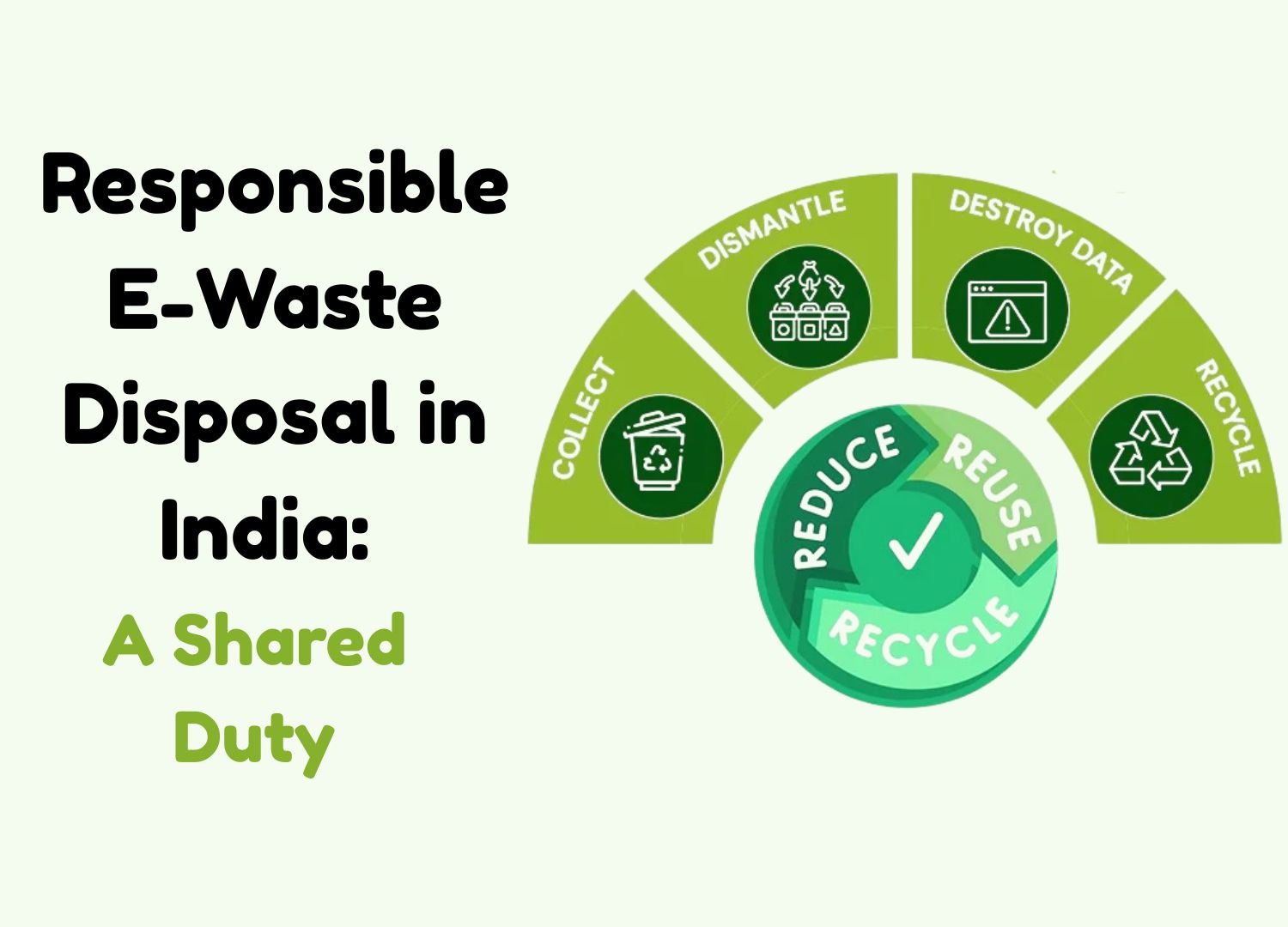
“Responsible E-Waste Disposal India”
India is now the third-largest generator of e-waste in the world, producing more than 3.2 million tonnes annually, according to the Central Pollution Control Board (CPCB). As our dependence on electronics grows, so does our responsibility to dispose of them safely. While much attention has been paid to the roles of producers and recyclers, the most important players in this process are often overlooked — consumers and bulk users. Their actions decide whether e-waste becomes a valuable resource or a toxic liability.
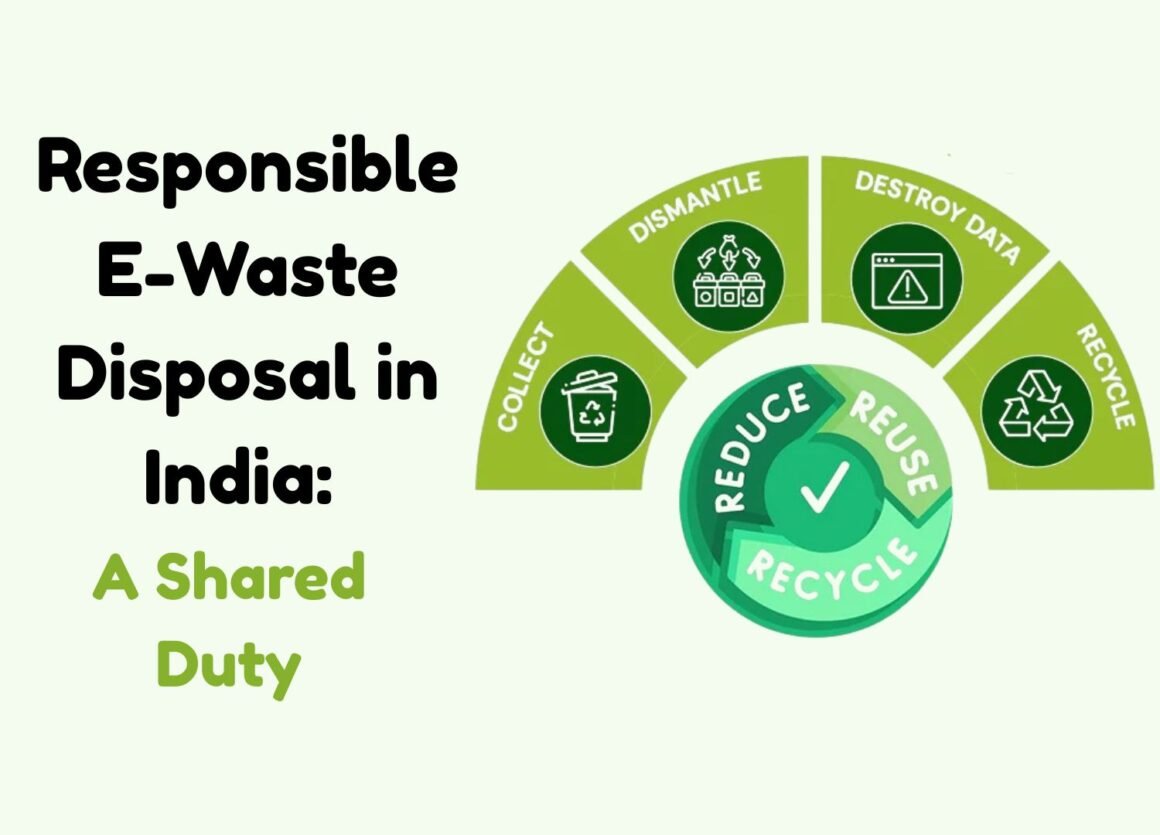
Responsible E-Waste Disposal India
The E-Waste (Management) Rules, 2022 classify these two stakeholder groups clearly:
- Consumers: Individuals or households using electronic and electrical equipment (EEE) for personal use.
- Bulk Users: Large entities like corporate offices, educational institutions, government departments, or data centers using more than 1,000 EEE units per year.
Both groups play a critical role in shaping India’s e-waste management chain. While consumers contribute smaller volumes individually, their collective impact is massive. Bulk users, on the other hand, produce large, concentrated volumes that require structured management systems.
Legal Responsibilities: From 2016 to 2022
Under E-Waste (Management) Rules, 2016:
Consumers and bulk users were legally obligated to:
- Channelize e-waste only through authorized collectors, dealers, dismantlers, or recyclers.
- Avoid mixing e-waste with household or hazardous waste.
- Store e-waste safely for a maximum of 180 days (extendable to 365 days with SPCB approval).
Bulk users had additional duties:
- Maintain records and inventories of e-waste generated and disposed of.
- Submit annual returns to SPCBs.
While these requirements were comprehensive, compliance remained weak due to low awareness and administrative complexity.
Under E-Waste (Management) Rules, 2022:
The 2022 update shifted the focus from administrative burden to operational responsibility:
- Consumers and bulk users must hand over e-waste only to registered entities (producers, refurbishers, or recyclers) listed on the CPCB online portal.
- Record-keeping and annual returns for bulk users were abolished to simplify compliance.
- Both categories must ensure e-waste is not mixed with municipal solid waste.
The shift from paperwork to portal emphasises real action over formality, pushing bulk users to engage directly with registered recyclers.
Why Responsible E-Waste Disposal India
a) The First Link in the Chain
Every device’s recycling journey begins when a consumer or bulk user decides to discard it. Their choice of disposal channel determines whether the device enters the formal recycling network or ends up in the informal sector, where unsafe recycling methods are rampant.
b) Volume and Influence
Bulk users like IT companies, schools, and government agencies handle massive quantities of electronic equipment. Their systematic compliance not only prevents environmental pollution but also sets a benchmark for smaller organizations and households.
c) Data and Security Risks
For bulk users, especially in banking or IT sectors, improper disposal can lead to data breaches. Certified recyclers ensure secure destruction of data-bearing devices, an aspect informal handlers often ignore.
d) Economic Impact
India’s discarded electronics contain valuable metals worth over ₹15,000 crore annually. When consumers and bulk users channelise e-waste properly, they enable recovery of these resources, fueling the circular economy.the
The Informal Sector: A Parallel System
Despite strong laws, around 70–90% of India’s e-waste still flows through informal collectors, locally known as kabadiwallas. They offer immediate cash to consumers, making them the preferred option. However, their crude recycling practices — burning wires, acid baths, and manual dismantling — cause severe health and environmental damage.
Formal recyclers struggle to compete because they must follow safety protocols and pay compliance costs. Therefore, integrating informal collectors into the formal e-waste supply chain through certification and training programs is crucial.
Challenges in Responsible E-Waste Disposal India”
- Low Awareness: A 2023 survey by MAIT found that 60% of consumers didn’t know where to dispose of e-waste formally.
- Convenience vs Compliance: Informal collectors are accessible, while registered collection centers may be few and far between.
- Cost of Collection: For bulk users, transportation and packaging of obsolete equipment add to operational costs.
- Weak Enforcement: SPCBs often lack manpower for on-ground inspections.
- Data Management: Even though returns are abolished, tracking disposal volumes remains a challenge.
Best Practices for Responsible E-Waste Disposal India
For Consumers:
- Use Authorized Channels: Always hand over devices to CPCB-registered recyclers or brand take-back programs.
- Participate in Collection Drives: Municipal corporations and NGOs frequently organize e-waste drop-off events.
- Secure Data Before Disposal: Delete sensitive files or remove storage drives.
- Say No to Informal Buyers: Avoid selling e-waste to unregistered scrap dealers.
For Bulk Users:
- Develop an Internal E-Waste Policy: Include disposal responsibilities within the organization’s ESG or CSR framework.
- Engage with Producer Responsibility Organizations (PROs): They manage logistics, collection, and documentation.
- Schedule Regular Pickups: Partner with formal recyclers for periodic collections.
- Maintain Transparency: Publish e-waste management efforts in sustainability reports.
- Encourage Employee Awareness: Train staff to handle e-waste responsibly.
Successful Indian Models
- Thiruvananthapuram’s Haritha Karma Sena: A women-led initiative collecting 33,000+ kg of e-waste monthly, showing community-led success.
- Mumbai’s BMC Drive: A collaboration with formal recyclers collected 15,000 kg of e-waste in a few months through doorstep pickups.
- Delhi’s E-Waste Eco Park: India’s first integrated facility aims to formalize informal workers and process thousands of tonnes safely.
These examples highlight that local participation and clear communication are key to large-scale success.
Global Comparisons: Lessons for India
Countries like Japan, Germany, and South Korea have strong consumer engagement policies:
- Deposit-Refund Schemes: Consumers pay a small fee when buying electronics, refunded upon return.
- Extended Producer Responsibility: Producers finance collection, making it easy for consumers to return items.
- Mandatory Collection Points: Supermarkets and retailers are required to accept old electronics.
India can adapt these strategies by offering incentives and integrating e-waste bins into public spaces.
Towards Behavioral Change
Responsible e-waste disposal requires behavioral transformation:
- Consumers must understand that convenience should not outweigh environmental impact.
- Bulk users should treat e-waste disposal as part of their sustainability and compliance agenda.
- Schools and colleges can play a key role in building early awareness through environmental education programs.
The government’s Mission LiFE (Lifestyle for Environment) initiative aligns perfectly with this goal — promoting sustainable consumption at every level.
Conclusion: Responsible E-Waste Disposal India
E-waste management is not merely about compliance; it’s about collective consciousness. Consumers and bulk users hold the power to bridge the gap between waste generation and responsible recovery. Each responsible action — a handover to a certified recycler, a corporate take-back program, or a small act of awareness — adds up to a national movement.
By embracing responsible disposal, India can turn its e-waste crisis into a green opportunity, paving the way for cleaner cities, safer recycling, and a truly circular economy.
FOR MORE BLOGS – beyondthepunchlines.com

Author: Team BTP

 Add to favorites