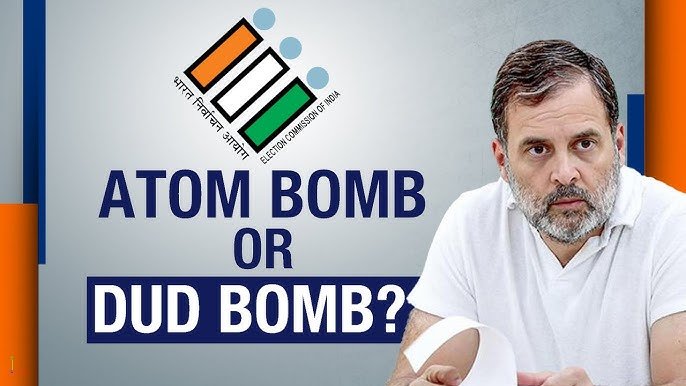
What was promised as explosive proof shook headlines, but ended up raising more doubts than impact.
The Big Claim
Congress leader Rahul Gandhi had promised what he called an “atom bomb” against the Election Commission of India (ECI)—allegations of large-scale voter fraud in Karnataka’s Mahadevapura constituency. He claimed the ECI was complicit in helping the BJP through fake and duplicate voters, suggesting this evidence would shake the foundations of India’s democracy.
The Reality Check
When the much-anticipated revelations came, they lacked the thunder Gandhi had promised. The so-called bomb turned into what critics now call a “damp sparkler.”
- Fact-checkers and journalists found no corroborative proof of mass duplication across states.
- The Election Commission dismissed the claims as baseless and irresponsible.
- BJP leaders, including Rajnath Singh, ridiculed the allegations, branding them political theatrics.
Political Fallout
- ECI’s Response: The Commission issued a stern rebuttal, asking Gandhi to file an affidavit within 7 days or apologise.
- Opposition’s Stand: INDIA bloc leaders backed Gandhi but faced pressure to show concrete evidence.
- Public Perception: What could have been a breakthrough moment for Gandhi became a talking point about exaggeration, with critics highlighting his tendency for dramatic claims.
Opposition’s Dilemma
- INDIA Bloc Support: Gandhi’s allies rallied behind him, defending his right to question institutions.
- Political Cost: Yet, the absence of hard evidence left them vulnerable to charges of exaggeration and undermined the seriousness of their campaign.
- Public Perception: For many, the incident reinforced an image of Gandhi as a politician prone to dramatic claims that struggle to withstand scrutiny.
Why It Fizzled
The controversy highlights a key challenge in Indian politics: sensational claims without airtight evidence risk undermining credibility. Gandhi’s bombshell announcement rallied attention but, without legal or empirical backing, it gave his rivals a chance to paint him as unreliable.
Rahul Gandhi’s “atom bomb” moment was a reminder that in today’s hyper-fast media and political environment, evidence is the only true explosive. Without it, even the loudest blast risks being remembered as just smoke and sparkles.
FOR MORE BLOGS – beyondthepunchlines.com

Author: Team BTP

 Add to favorites


