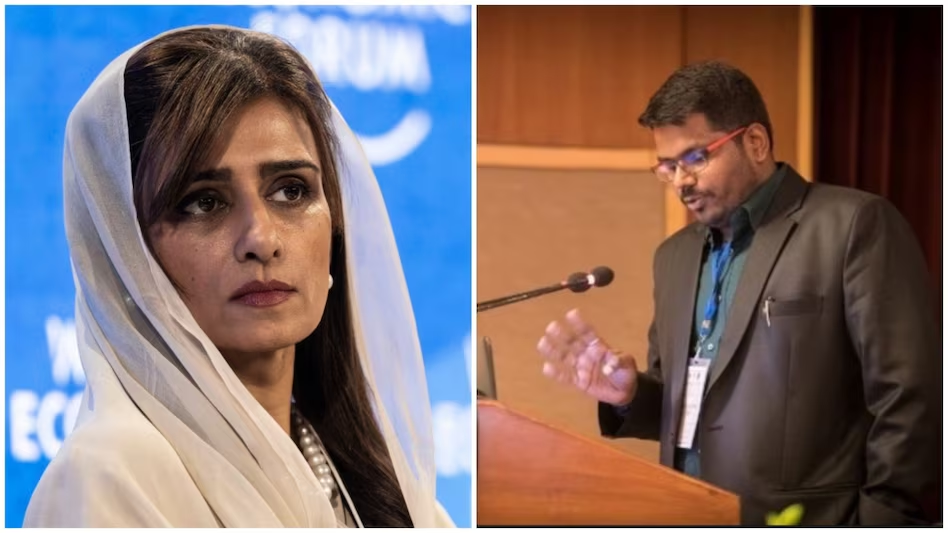
On 27 November 2025, the Oxford Union was set to host a high-profile debate titled “This House Believes That India’s Policy Towards Pakistan Is a Populist Strategy Sold as Security Policy.” The event, however, ended in confusion and controversy before it even began. Pakistan claimed that India withdrew from the debate, suggesting a walkover victory.
But senior Indian lawyer and speaker, J Sai Deepak, publicly exposed that this claim was false, providing detailed evidence that the Indian delegation was ready to participate and had assembled a team of replacement speakers at the last minute.
According to Sai Deepak, top scheduled speakers, including a former army chief and a politician, had to withdraw due to prior commitments. Despite this, he acted quickly to ensure India would still have representation, assembling a team of UK-based Indian speakers willing to debate on extremely short notice.
Deepak flew to London, coordinated with the team, and prepared extensively for the scheduled event, demonstrating commitment and readiness to uphold India’s perspective.
Hours before the event, organizers informed Deepak that the Pakistani delegation had allegedly not arrived, using this as justification for canceling the debate. Deepak and his team waited at the venue, ready to participate, only to discover later that the Pakistani delegation was in fact present at the same Oxford hotel.
This revealed that the cancellation was based on misinformation or miscommunication from the organisers. Deepak criticised the Oxford Union for allowing Pakistan to claim a false victory and described the situation as a deliberate misrepresentation, humorously dubbing it an “Operation Manhoos ki phati hui Baniyan.”
The controversy has sparked broader discussions on the integrity and management of international academic debates. It highlights how easily narratives can be manipulated in real time to influence public perception. Media outlets, diplomatic channels, and the general public were initially led to believe that India had withdrawn, giving the Pakistani side an undeserved claim of victory.
Deepak’s public clarification, backed by emails, call logs, and timelines, exposed the truth and reinforced the importance of evidence-based reporting.
Moreover, this incident raises critical questions about the responsibility of institutions like Oxford Union to maintain neutrality and fairness. Academic platforms are intended to promote intellectual discourse, but the events of 27 November illustrate how miscommunication or organizational bias can undermine these ideals.
It also demonstrates the pressures faced by speakers from diplomatic and politically sensitive contexts, who must navigate not just the debate topic but also the logistics, politics, and media attention surrounding such high-profile events.
Deepak’s response has been widely praised in India for defending the country’s honor and exposing the falsified claims. He emphasized that debates should remain spaces for reasoned argument, evidence, and dialogue, rather than platforms for propaganda or theatrical victories.
The incident serves as a cautionary tale for organizers, participants, and audiences alike: transparency, proper documentation, and accountability are essential to prevent misrepresentation and protect the credibility of all involved.
In conclusion, the Oxford Union debate row involving J Sai Deepak demonstrates how quickly narratives can be distorted in high-profile forums, the challenges of maintaining fairness in international events, and the critical role of truth and transparency in defending national and individual reputations.
It underscores the need for stronger protocols in managing debates and ensuring that all participants, regardless of nationality, are treated equitably and that the public receives accurate information.
FOR MORE BLOGS – beyondthepunchlines.com

Author: Team BTP

 Add to favorites