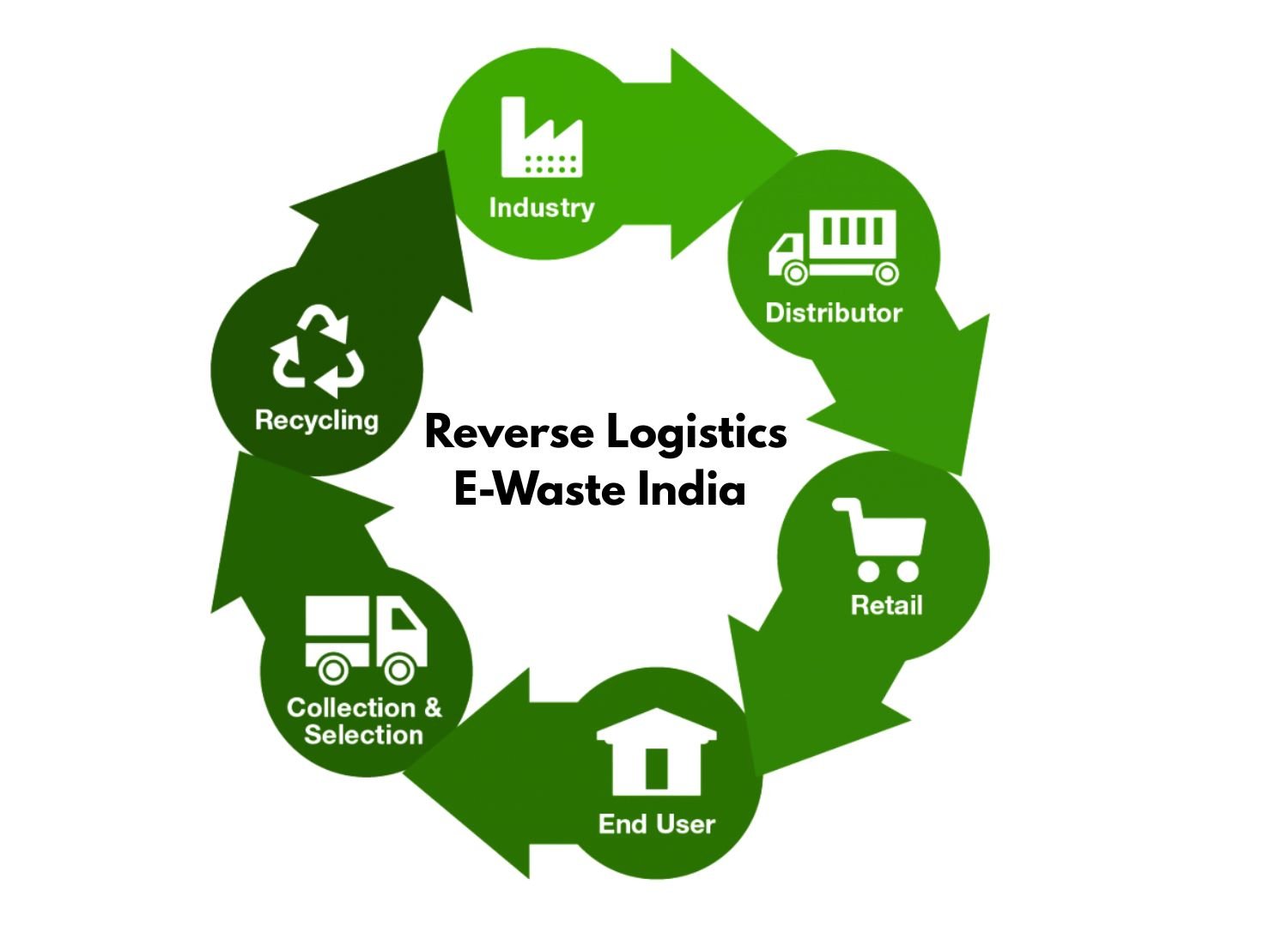
India’s e-waste reverse logistics: How E-Waste Travels from Homes to Recyclers”
India’s digital boom has not only revolutionized lifestyles but also created one of the world’s fastest-growing waste streams: electronic waste. From smartphones to refrigerators, almost every device has a finite life cycle. Once obsolete, it enters a reverse flow known as reverse logistics, the hidden half of the electronics industry.
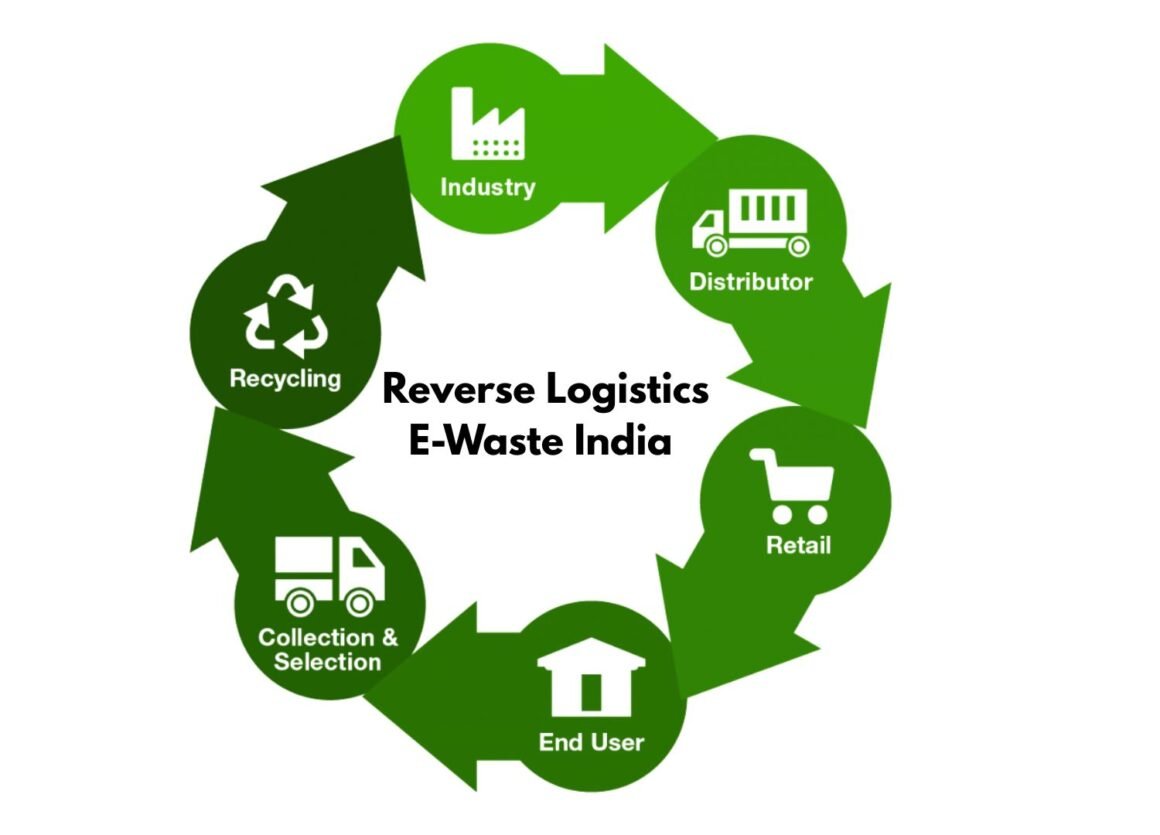
Reverse logistics ensures that products discarded by consumers make their way back to manufacturers, dismantlers, or recyclers — safely, efficiently, and sustainably. It’s an essential part of the circular economy, where resources are reused and waste becomes an opportunity.
Understanding India’s e-waste reverse logistics
In traditional logistics, goods move from manufacturers to consumers — a forward supply chain. Reverse logistics flips that direction, taking obsolete or damaged products backwards through the chain for repair, reuse, or recycling.
In India’s context, the E-Waste (Management) Rules, 2022 make reverse logistics legally binding. Producers, importers, and brand owners are responsible for collecting their products once they reach end-of-life. This process is known as Extended Producer Responsibility (EPR).
Key objectives of reverse India’s e-waste reverse logistics:
- Recover valuable materials like copper, gold, and palladium.
- Reduce landfill pressure by reusing recyclable components.
- Prevent pollution caused by informal dismantling and open burning.
- Create green employment opportunities across the value chain.
The India’s e-waste reverse logistics: Step-by-Step
Stage 1: Generation & Segregation
Every discarded phone, television, or laptop marks the beginning of the reverse journey. E-waste generation in India reached 3.2 million tonnes in 2023, yet less than 25% entered formal recycling systems. Consumers play the most crucial role — separating electronics from household waste ensures recyclability.
Stage 2: Collection & Pickup Channels
The collected devices enter the system through various pathways:
- Authorized collection centers run by recyclers or Producer Responsibility Organizations (PROs).
- Door-to-door pickup drives organized by municipalities and private companies.
- Drop boxes in malls, electronics shops, and service centers.
- Buy-back schemes by brands like Dell, HP, and Samsung that encourage consumers to return used gadgets.
However, over 70% of e-waste still flows through informal collectors — local scrap dealers (kabadiwallas) who pay cash for old devices. These unregulated channels often dismantle waste using unsafe, polluting methods.
Stage 3: Aggregation & Sorting
Once collected, e-waste is brought to aggregation or storage facilities. Here, workers segregate items into categories — reusable, refurbishable, or recyclable.
- Functional products are sent for refurbishment.
- Non-functional items are dismantled into components: plastic casings, printed circuit boards (PCBs), glass, and metals.
Proper storage with fireproof containment is crucial, especially for lithium-ion batteries and fluorescent lamps.
Stage 4: Reverse Transport & Logistics
Transportation is the backbone of India’s e-waste reverse logistics. Registered transporters use secure, labelled containers and maintain detailed manifests that include the type, source, and weight of the e-waste. GPS tracking and CPCB-approved transport documents ensure traceability.
Reverse logistics routes often mirror forward logistics — from city collection points to regional aggregation hubs, and finally to dismantling or recycling facilities. However, the challenge lies in volume imbalance — small, scattered collections make reverse transport expensive.
Stage 5: Dismantling & Component Separation
At authorized dismantling centers, workers carefully disassemble devices to separate recyclable and hazardous materials. This manual or semi-automated process includes:
- Removing hazardous elements (batteries, mercury lamps, CRTs).
- Sorting components for refurbishment, reuse, or material recovery.
- Preparing sorted fractions for specialized recyclers.
In the informal sector, this step is often done by burning wires to extract copper — a practice that releases deadly toxins. Formal dismantling replaces this with safe mechanical separation.
Stage 6: Recycling & Resource Recovery
Recycling plants use mechanical shredding, chemical leaching, and smelting to extract precious metals such as gold, silver, and palladium from PCBs. Plastics are recycled into pellets, while metals like aluminum and copper are refined for reuse in manufacturing.
Recyclers issue EPR Certificates, proving the amount of waste processed. Producers then use these certificates to meet their EPR obligations under CPCB’s online system.
Stage 7: Reporting & Feedback Loop
Finally, data on collected and recycled quantities are uploaded to CPCB’s portal. This digital feedback loop connects every actor — producer, recycler, and regulator — ensuring transparency and minimizing fraudulent reporting.
The Role of the Informal Sector
India’s e-waste economy cannot ignore the informal sector. Cities like Delhi, Moradabad, and Seelampur depend on unregulated recyclers for over 90% of e-waste handling. Though unsafe, these networks are efficient in collection and aggregation.
Integrating informal collectors into formal systems can create a win-win situation:
- Training and certification for informal workers.
- Buy-back partnerships between recyclers and scrap dealers.
- Financial incentives for collection through legal channels.
Delhi’s upcoming E-Waste Eco Park is a landmark project that aims to formalize informal collectors, providing safe dismantling zones and skill development programs.
Challenges in India’s e-waste reverse logistics
Despite policy progress, several bottlenecks persist:
- Cost-intensive logistics: Transporting dispersed e-waste is economically inefficient.
- Consumer behavior: Lack of awareness and low monetary incentives discourage formal recycling.
- Regulatory gaps: Uneven enforcement of CPCB registration across states.
- Capacity deficit: India’s formal recycling infrastructure handles less than 50% of generated e-waste.
- Data discrepancy: E-waste flow is hard to quantify due to parallel informal operations.
Without addressing these, India’s e-waste reverse logistics systems will continue to underperform.
Technological Innovations & Digital Oversight
To streamline the e-waste flow, several digital and technological solutions are emerging:
- Blockchain traceability: Enables tamper-proof tracking of e-waste through each stage.
- AI-based sorting machines: Used for automated separation of metals and plastics.
- Geo-tagged collection apps: Allow citizens to locate nearby collection centers.
- Reverse vending machines: Deployed in malls to accept small electronics in exchange for coupons.
CPCB’s digital EPR portal is a milestone — it integrates data from producers and recyclers, verifying that actual recycling matches declared volumes.
Global Best Practices for India’s e-waste reverse logistics
Countries like Japan, South Korea, and Germany operate highly efficient reverse logistics frameworks. Their success relies on three key principles:
- Producer Responsibility: Strict laws requiring manufacturers to fund collection and recycling.
- Consumer Incentives: Refundable deposits and easy drop-off networks.
- Advanced Infrastructure: Automated recycling facilities with real-time monitoring.
In India, models like Kerala’s Haritha Karma Sena and Mumbai’s BMC collection drives reflect early success stories — but scaling them nationwide requires central coordination and investment.
Economic & Environmental Impact
India’s e-waste reverse logistics is not just a compliance requirement — it’s an economic opportunity:
- E-waste in India contains recoverable metals worth over ₹15,000 crore annually.
- Recycling 1 tonne of e-waste saves 1.44 tonnes of CO₂ emissions compared to mining virgin materials.
- Each 1,000 tonnes of e-waste recycled can generate 50–80 green jobs in logistics, dismantling, and recycling.
India’s e-waste reverse logistics transforms waste into wealth while reducing the nation’s dependence on imported raw materials.
Future of India’s e-waste reverse logistics
As India transitions toward a circular electronics economy, the focus will be on:
- Integrating informal collectors into digital tracking networks.
- Creating regional recycling hubs to reduce logistics costs.
- Implementing AI and robotics for material recovery.
- Strengthening cross-state coordination via CPCB’s portal.
Public-private partnerships, consumer incentives, and transparent monitoring will define the next phase of India’s reverse logistics transformation.
Conclusion: India’s e-waste reverse logistics
India’s e-waste reverse logistics is the silent engine driving India’s green future. Every collected phone, dismantled motherboard, or recycled laptop helps recover valuable metals, reduce pollution, and promote sustainability. With stronger enforcement, public awareness, and technological innovation, India can build a circular economy where nothing truly goes to waste.
FOR MORE BLOGS – beyondthepunchlines.com

Author: Team BTP

 Add to favorites