India–Russia Relations – A strategic pact that could redefine defence mobility, Russia relations, global reach, and the future architecture of military logistics.
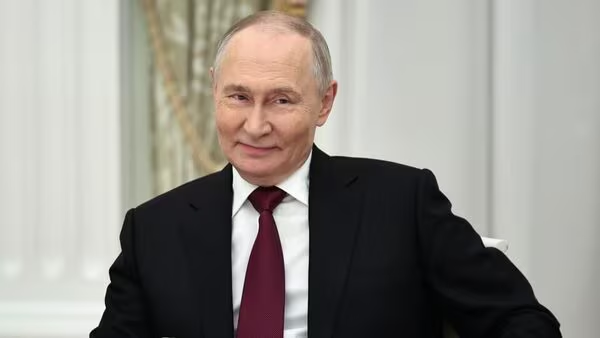
The stage is set for one of the most consequential diplomatic engagements of the year as Russian President Vladimir Putin prepares to visit India on December 4–5, 2025. Days before this high-stakes meeting, the Russian State Duma cleared a landmark military logistics pact with India—an agreement widely seen as a turning point in how the two nations cooperate on defence, mobility, and long-range operations.
This development is crucial because it comes at a time when global politics is shifting faster than ever. Countries are rethinking alliances, building new partnerships, and strengthening old ones. India and Russia, who have shared decades of defence cooperation, are now taking their relationship to the next level. With the approval of this pact, both nations are sending a clear message: their strategic partnership remains strong, relevant, and future-focused.
For readers trying to understand why this is important—think of the agreement as giving both militaries the ability to support each other anytime, anywhere. Refuelling, supplies, maintenance, and logistics that earlier required complex planning will now become much smoother.
This means quicker response times, better coordination, and a stronger military presence wherever needed. In simple words, it makes both countries more capable, more flexible, and more prepared for global challenges.
What Is the RELOS Agreement?
The Reciprocal Exchange of Logistics Support Agreement (RELOS) is a powerful mechanism that allows the militaries of both countries to use each other’s bases, ports, and logistical infrastructure for refuelling, maintenance, supplies, medical support, and troop movement. For India, which is rapidly modernising its armed forces and expanding maritime reach, the pact enhances operational flexibility like never before.
Key Features of RELOS: India-Russia relations
- Access to Russian naval ports and airbases for Indian warships and aircraft.
- Reciprocal access for Russian military assets in Indian facilities.
- Streamlined procedures for joint exercises and humanitarian operations.
- A stronger mechanism for large-scale troop, equipment, and logistics movement.
- A long-term framework to deepen defence interoperability.
Why the Timing Matters: India–Russia Relations
The approval of this agreement just before Putin’s arrival is not merely procedural—it is political signalling. It reflects Russia’s intent to strengthen defence ties with India at a time when Moscow is recalibrating its global alliances due to Western sanctions and geopolitical pressure. For India, the pact aligns with its long-standing doctrine of strategic autonomy, ensuring it maintains balanced relationships with major global powers.
Strategic Significance for India
India’s maritime expansion, particularly in the Indian Ocean Region (IOR), receives a major boost under RELOS. Russian ports in the Arctic and the Far East could potentially open new avenues for India’s strategic footprint.
Benefits for India’s Defence & Geopolitical Positioning
- Expanded presence in the Arctic region through Russian military infrastructure.
- Enhanced operational support during long-range naval missions.
- Stronger energy and defence corridor between India and Russia.
- Improved readiness and streamlined logistics during joint operations.
- A counterbalance to China’s growing influence in Eurasia and the Indo-Pacific.
How Russia Benefits: India–Russia Relations
For Moscow, the partnership is equally valuable. With the West imposing restrictions and NATO expanding its influence, Russia views India as a stable, reliable partner with whom it shares decades of defence trust.
Russia’s Gains from RELOS: India–Russia Relations
- Access to one of the world’s largest military logistics networks in the Indian Ocean.
- Strengthening of India–Russia Relations: defence-industrial base.
- Increased military engagement to offset Western pressure.
- A more reliable Asian partner for joint development and energy cooperation.
Broader Context: A Shifting World Order
The global landscape is undergoing rapid transformation. The Russia–India summit comes at a time when global supply chains, defence alignments, and political blocs are being reshaped. RELOS amplifies India’s role as a pivotal Indo-Pacific player and reinforces Russia’s relevance as a long-term defence partner.
What to Expect from Putin’s India Visit
The logistics pact is only the beginning. The summit is expected to produce several significant outcomes:
- New defence manufacturing projects under “Make in India.”
- Expansion of nuclear energy cooperation.
- A sanctions-resistant financial mechanism to boost bilateral trade.
- Stronger collaboration in space technology and the Arctic.
Conclusion: India-Russia relations
The approval of the military logistics pact ahead of Vladimir Putin’s India visit reflects a renewed strategic commitment. It is more than an agreement—it is a statement of intent.
As India redefines its position in the global order and Russia seeks stable partnerships beyond the West, RELOS could become a cornerstone of next-generation defence cooperation. The world will be watching closely as New Delhi and Moscow chart a new course for their military and geopolitical future.
FOR MORE BLOGS – beyondthepunchlines.com

Author: Team BTP

 Add to favorites