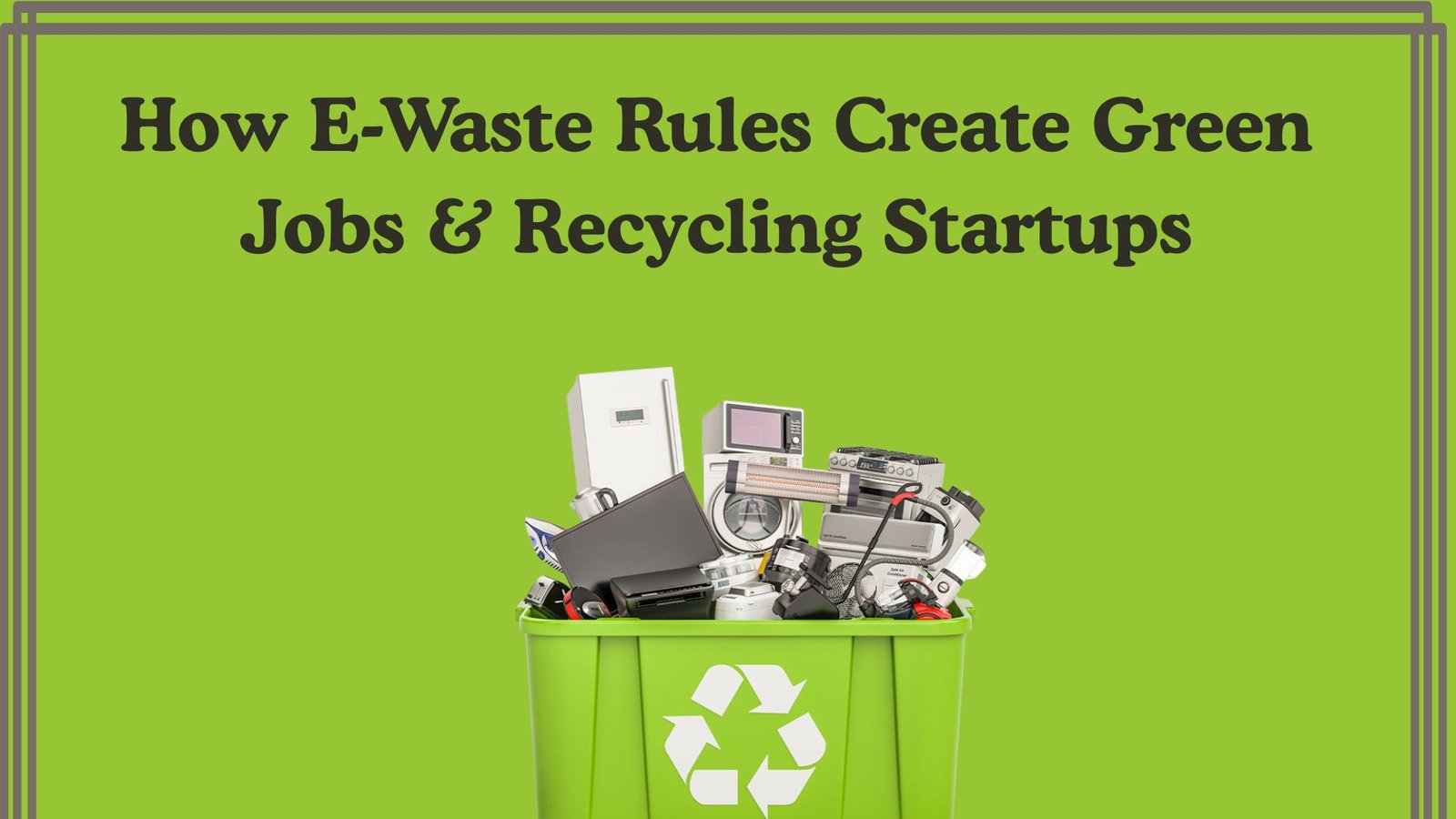
E-Waste Rules Promote Green Jobs & Recycling Startups — turning digital waste into economic wealth. India’s E-Waste Rules are not just cleaning up the planet; they are empowering a new wave of green entrepreneurs, circular startups, and sustainable job creators who are redefining the future of responsible innovation.”
E-waste is no longer a niche environmental issue; it is now a major economic and employment opportunity. With India generating over 1.75 million metric tonnes of e-waste annually, the focus has shifted from waste disposal to resource recovery and green entrepreneurship.
The E-Waste (Management) Rules, 2022, implemented by the Ministry of Environment, Forest and Climate Change (MoEFCC) and enforced by the Central Pollution Control Board (CPCB), have been instrumental in formalising the recycling ecosystem. This transformation is creating a new wave of green jobs, sustainable startups, and eco-innovation hubs.
The Green Economy Multiplier Effect
E-waste management not only prevents pollution but also fuels a circular economy that generates both employment and investment. According to the International Labour Organisation (ILO), the global transition to a circular economy could create 18 million green jobs by 2030. In India, every 1,000 tonnes of e-waste processed formally can create 15 to 20 jobs in logistics, dismantling, testing, and compliance monitoring.
India’s recycling market, currently valued at USD 3.2 billion, is projected to grow at a CAGR of 14.2% between 2024 and 2030. The push from EPR (Extended Producer Responsibility) has made this sector one of the most promising domains for sustainable entrepreneurship.
How E-Waste Rules Promote Green Jobs & Recycling Startups
1. Formalization through CPCB Registration
The CPCB E-Waste Portal allows recyclers, dismantlers, and refurbishers to register online, track compliance, and issue EPR certificates. This digital transparency encourages startups to operate legitimately while offering traceability to producers.
Why it matters:
- Boosts credibility for recycling startups.
- Ensures data transparency and compliance audits.
- Reduces the influence of the informal recycling sector.
2. Rise of Recycling Tech Startups
Technology is transforming e-waste recycling into a high-value industry. Startups like Attero Recycling, Karo Sambhav, and Recykal are leveraging IoT, blockchain, and AI to create data-driven, transparent systems for collection and material recovery.
Innovation areas include:
- AI-based Waste Sorting – Smart sensors and robotic sorting arms identify valuable components.
- Blockchain Traceability – Platforms track the movement of e-waste and validate recycling credits.
- Urban Mining – Scientific extraction of gold, copper, cobalt, and lithium from discarded electronics.
These innovations align with the Digital India Mission and are supported by policies like Startup India, Make in India, and PLI schemes for electronics manufacturing.
3. Integration of the Informal Sector
Nearly 95% of e-waste in India is processed informally. The 2022 Rules promote collaboration between formal recyclers and informal workers, offering training, certification, and safety standards under programs like Skill India’s Green Jobs Initiative.
Outcome:
- Better health and safety standards for workers.
- Increased recycling efficiency.
- Enhanced material recovery yield.
4. Incentives and Tax Benefits for Recycling Startups
The government has announced multiple incentives for e-waste recyclers:
- Subsidized loans for recycling unit setup under MSME and SIDBI schemes.
- 100% tax deduction on R&D expenditure in recycling technologies.
- Priority lending category for green enterprises under RBI guidelines.
- State-level capital subsidies for units established in notified Green Industrial Parks.
The Economic Value of Circularity
E-waste recycling contributes directly to India’s economy by reducing import dependence on critical minerals. Recovering just 10% of the metals from India’s annual e-waste can save ₹25,000 crore in foreign exchange. With the government’s ₹1,500 crore Critical Mineral Recycling Scheme (2025), startups focusing on lithium-ion battery and rare earth recovery stand to benefit immensely.
Case Study: Attero Recycling
Attero, India’s largest e-waste recycler, processes over 144,000 tonnes of e-waste annually and recovers gold, copper, and aluminum worth millions. The company plans to expand globally, showcasing how Indian recyclers can achieve international competitiveness.
State Initiatives and Regional Opportunities
- Delhi: Building India’s first E-Waste Eco Park at Holambi Kalan; expected to generate 1,000+ jobs.
- Haryana: Proposing a dedicated e-waste industrial hub in Manesar with land and tax subsidies.
- Karnataka: Partnering with startups to launch community-based collection programs.
- Maharashtra: Digitizing waste tracking through blockchain-powered systems.
These regional projects are critical for achieving the national e-waste collection targets and boosting local entrepreneurship.
Challenges Still to Overcome
Despite rapid progress, challenges persist:
- Low Consumer Awareness: Only 20% of users know how to dispose of e-waste responsibly.
- High Logistics Costs: Transporting small-volume waste from rural areas is unprofitable.
- Non-uniform Enforcement: Weak inspection systems allow non-compliant recyclers to thrive.
- Commodity Price Volatility: Fluctuations in global metal prices affect recycler profitability.
To counter these issues, the government must focus on public awareness campaigns, PPP (Public-Private Partnership) models, and innovation funding through the National Clean Energy Fund.
How E-Waste Rules Promote Green Jobs & Recycling Startups in India
By 2030, India’s e-waste management sector is projected to create over 500,000 green jobs, spanning collection, logistics, design, research, and data management. Skill development under Skill India and National Green Skill Mission (NGSM) will ensure a trained workforce ready for these roles.
Emerging business models like Product-as-a-Service (PaaS), Device Leasing, and Circular Design Consulting will also fuel a new wave of sustainability-driven enterprises.
E-Waste Rules Promote Green Jobs & Recycling Startups—they are an industrial policy for the future. By combining EPR mandates, startup innovation, and green financing, the country is turning its e-waste challenge into a trillion-rupee circular economy opportunity. As awareness grows and enforcement strengthens, India is set to lead the global movement for sustainable recycling, inclusive growth, and climate resilience.
FOR MORE BLOGS – beyondthepunchlines.com

Author: Team BTP

 Add to favorites