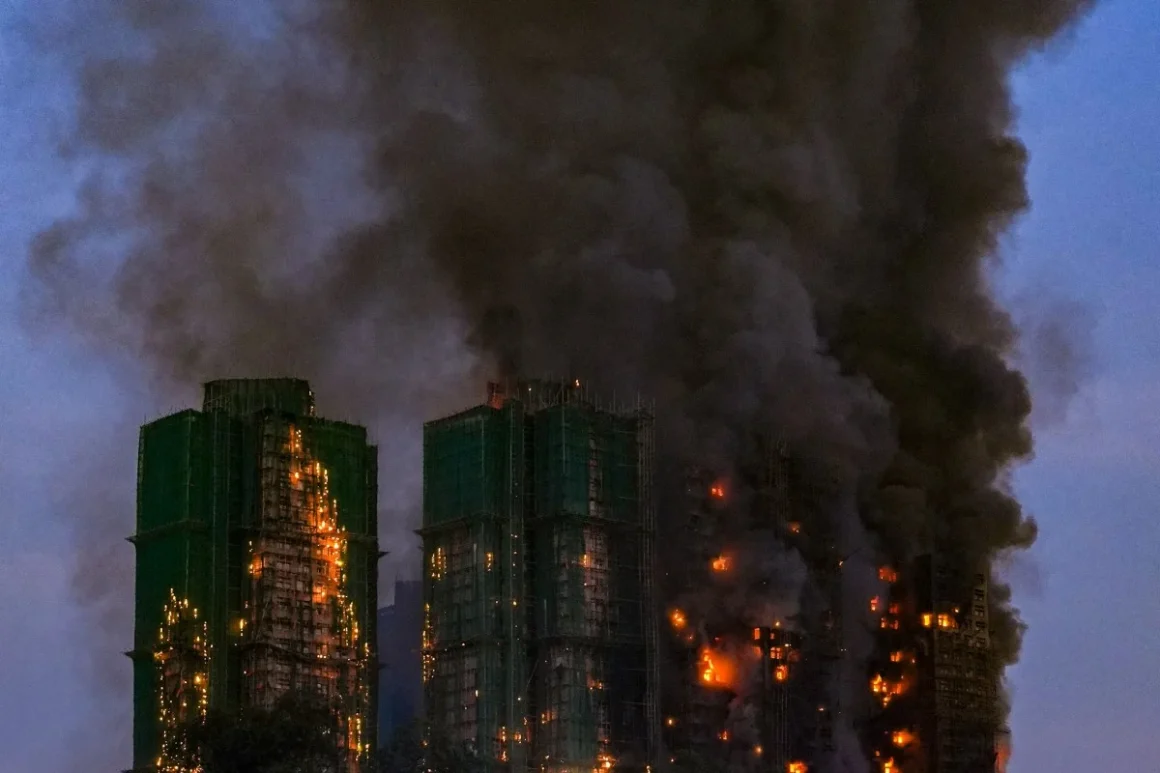
On 26 November 2025, tragedy struck the Tai Po district of Hong Kong when a massive fire engulfed Hong Kong Wang Fuk Court Fire, a high-rise residential complex housing thousands of residents. Within minutes, flames spread across multiple towers, resulting in a devastating death toll and leaving hundreds injured or missing.
Early reports and social media videos have drawn attention to a construction worker seen smoking a cigarette near the building just moments before the fire erupted, raising questions about the possible cause of the blaze.
Hong Kong Wang Fuk Court Fire comprises eight 31–32-storey towers, home to roughly 4,800 residents. On the day of the incident, the fire reportedly began in one of the towers around 14:51 HKT and spread rapidly.
The combination of bamboo scaffolding, plastic netting used during renovations, and flammable protective foam is believed to have fueled the fire’s vertical spread, transforming a single spark into a catastrophic blaze. Emergency responders arrived within minutes, but the speed of the fire and the height of the towers made containment extremely challenging.
As of now, the confirmed death toll stands at 128, including a firefighter, with over 79 people injured and hundreds still unaccounted for. Many survivors described the terrifying scenes of flames consuming entire floors within minutes, with smoke and debris making escape difficult.
Residents were forced to jump from windows or wait on rooftops to be rescued, highlighting both the intensity of the blaze and the inadequacy of safety measures in place during renovations.
The viral video showing a worker smoking has intensified public scrutiny, suggesting the cigarette may have acted as the ignition source. Authorities, however, have not officially confirmed this as the cause, emphasising that investigations are still underway.
Fire safety experts note that even if the cigarette played a role, poor construction practices, flammable renovation materials, and malfunctioning fire alarms significantly contributed to the scale of the disaster. The incident has ignited a city-wide conversation about urban safety standards and the responsibilities of construction companies during high-risk projects.
Residents and safety advocates have expressed outrage, noting that previous complaints about fire hazards, malfunctioning alarms, and risky renovation practices were allegedly ignored. The tragedy has sparked comparisons with past high-rise fires worldwide, such as the Grenfell Tower fire in London, highlighting systemic lapses in urban safety regulations and enforcement.
Families of the victims have demanded accountability from construction firms, government regulators, and building management, calling for stricter inspections and preventive measures to avoid future catastrophes.
Hong Kong Wang Fuk Court Fire police have arrested several construction-related individuals and companies for possible negligence and are conducting detailed inquiries into building safety compliance, fire protocols, and emergency response effectiveness. Government officials have pledged a full investigation, promising reforms to prevent similar incidents in the future.
There is also growing pressure to improve emergency response training for residents of high-rise buildings and to implement more robust fire-safety regulations during construction and renovation projects.
The Hong Kong Wang Fuk Court fire serves as a grim reminder of the importance of strict adherence to fire safety regulations, proper supervision during renovations, and the enforcement of strict no-smoking rules on construction sites.
Authorities, residents, and policymakers are now reflecting on lessons to ensure that high-density urban housing remains safe, that residents are educated about emergency procedures, and that tragic events like this can be prevented in the future. Public awareness campaigns, stricter penalties for negligence, and advanced fire-resistant building materials are now being discussed as critical measures to safeguard Hong Kong’s residents against similar disasters.
FOR MORE BLOGS – beyondthepunchlines.com

Author: Team BTP

 Add to favorites