Thiruparankundram Today: Fresh Developments
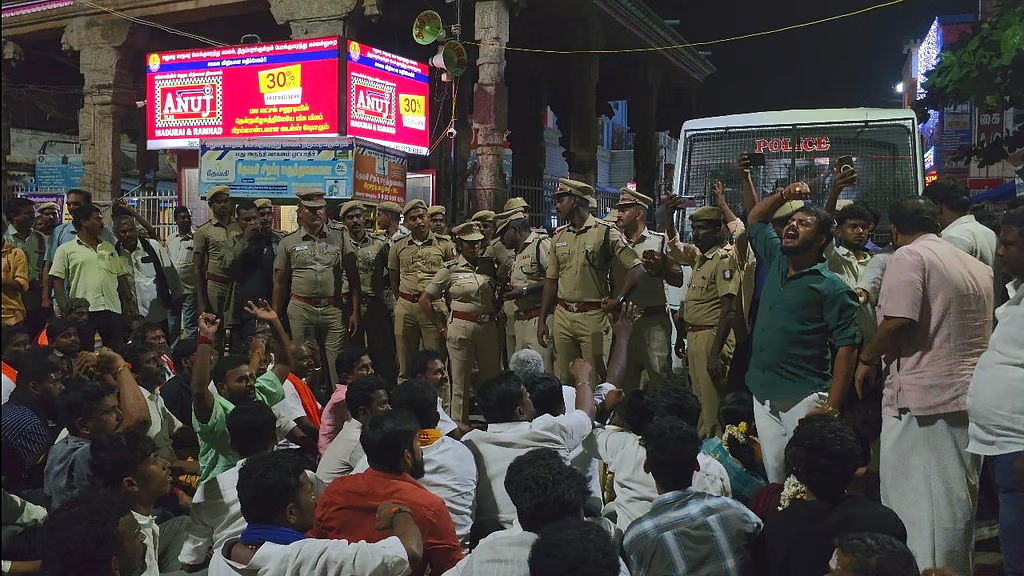
On 8 December 2025, Thiruparankundram hill near Madurai, Tamil Nadu, witnessed renewed tension as large-scale mobilisation by Sangh Parivar-affiliated outfits escalated into confrontations with police. The unrest was centred around the Karthigai Deepam festival, where activists attempted to light lamps at a disputed hilltop location, traditionally shared between the Murugan temple and Sikandar Badusha Dargah. Prohibitory orders were enforced, yet hundreds attempted to breach barricades, leading to clashes and injuries.
Background: The Hill of Shared Heritage
Thiruparankundram is historically significant, featuring the Murugan temple, the Dargah, and ancient Jain caves. It has been a site of religious coexistence for centuries. In recent years, certain groups have pushed to assert exclusive ritual claims, turning the hill into a flashpoint. The 2025 Karthigai Deepam festival saw demands to light the traditional lamp at the “deepathoon” stone pillar — a move seen by many as a political assertion rather than a purely ritual act.
Organised Mobilisation: What the Ground Report Reveals
- Pre-planned Movement: Activists from various districts, including Dindigul, Erode, and Theni, coordinated arrival via vehicles adorned with BJP flags and loudspeakers.
- Saffron Presence: Cadres from BJP, RSS, Hindu Munnani, and Hindu Makkal Katchi organised chants, bhajans, and public speeches, indicating strategic mobilisation rather than spontaneous gathering.
- Festival Cover: The Karthigai Deepam festival was used as a façade to assert majoritarian claims over shared sacred spaces.
- Symbolic Actions: Activists attempted to light the lamp at the controversial “deepathoon” despite prohibitory orders, signalling a political-religious statement.
Clashes and Security Response
- Police Injuries: At least four policemen were reportedly injured during attempts to control the crowd.
- Preventive Measures: Prohibitory orders under BNSS (formerly Section 144 CrPC) were strictly enforced.
- Arrests: 93 individuals, including BJP leaders like Nainar Nagendran and H. Raja, were booked for violating prohibitory orders.
- Community Impact: Local residents were restricted to individual worship; group pilgrimages were barred to prevent further escalation.
Political and Social Reactions: Thiruparankundram
- State Government: CM M.K. Stalin condemned divisive politics, emphasising that religion should foster unity, not conflict.
- Opposition Voices: Parties like VCK and Congress criticised the state for leniency toward Hindutva outfits and potential communal polarisation.
- Civil Society Concern: The organised mobilisation risks eroding long-standing communal harmony and could set a precedent for other contested religious sites in India.
Implications for Tamil Nadu and Beyond: Thiruparankundram
- Rituals as Political Tools: Religious festivals are increasingly being used to assert political and religious dominance.
- Heritage Sites at Risk: Shared spaces like Thiruparankundram hill face challenges to coexistence and secular traditions.
- Communal Polarisation: Strategic mobilisation under the guise of devotion can heighten tensions and social distrust.
Conclusion
The events at Thiruparankundram on 8 December 2025 highlight how organised Sangh mobilisation can transform religious festivals into political spectacles. Ensuring communal harmony and protecting shared heritage requires proactive governance, impartial law enforcement, and active civil society engagement. Without these, flashpoints like Thiruparankundram could recur across Tamil Nadu and India, threatening centuries-old traditions of coexistence.
FOR MORE BLOGS – beyondthepunchlines.com

Author: Team BTP

 Add to favorites