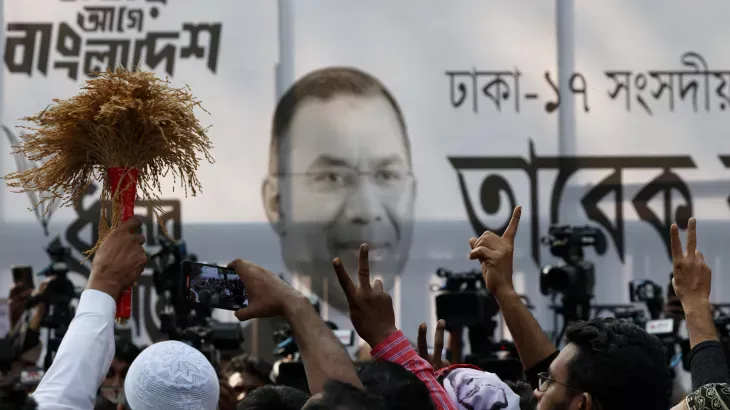
BNP coming to power in Bangladesh: From strategic anxiety to cautious engagement, India’s Bangladesh policy reflects shifting regional realities.
For years, policymakers in New Delhi viewed the possibility of the Bangladesh Nationalist Party (BNP) returning to BNP coming to power in Bangladesh as a strategic setback. The phrase “worst-case scenario” was often used in diplomatic and security circles to describe a potential BNP-led government in Dhaka.
The concern was rooted in historical experience, geopolitical calculations, and security considerations that shaped India’s foreign policy outlook in South Asia. Today, however, the narrative appears to be evolving. What was once considered a diplomatic risk is now being approached with cautious pragmatism.
Historical Context: The 2001–2006 Phase
The origins of Delhi’s apprehension date back to the BNP’s previous tenure in power between 2001 and 2006. During that period, bilateral relations between India and Bangladesh experienced visible strain.
Indian security agencies expressed concerns over:
- Alleged shelter to insurgent groups operating in India’s Northeast
- Limited cooperation on counter-terrorism mechanisms
- Rising anti-India rhetoric in Bangladeshi domestic politics
Although Bangladesh consistently denied facilitating anti-India activities, perceptions within Indian strategic circles hardened during that period.
The experience contrasted sharply with the cooperative engagement witnessed under the Awami League government led by Sheikh Hasina. Under her leadership, India and Bangladesh expanded security cooperation, resolved long-pending border disputes, and deepened economic ties.
As a result, New Delhi came to view the Awami League as a stable and predictable partner.
Why BNP’s Return Was Viewed with Concern
Several factors contributed to India’s earlier anxiety regarding BNP’s return:
1. Security Concerns
Cross-border insurgency in India’s Northeast has historically been a sensitive issue. Any perceived relaxation of vigilance by Dhaka was viewed as a direct threat to Indian internal security.
2. Strategic Alignment
The BNP was seen as less inclined toward close strategic alignment with India and more focused on balancing regional powers.
3. Political Rhetoric
BNP leaders often emphasized sovereignty and national independence in foreign policy discourse. While this is standard political positioning, it was sometimes interpreted in Delhi as resistance to Indian influence.
4. Regional Geopolitics
South Asia’s geopolitical landscape has become increasingly competitive. Any change in Dhaka’s political orientation carries implications for maritime security in the Bay of Bengal and broader Indo-Pacific dynamics.
India-Bangladesh Relations Under the Awami League
Over the past decade and a half, India and Bangladesh witnessed unprecedented cooperation.
Key milestones included: BNP coming to power in Bangladesh
- The 2015 Land Boundary Agreement implementation
- Enhanced energy connectivity projects
- Trade expansion and infrastructure integration
- Maritime and counter-terror cooperation
This era of strategic convergence shaped Indian expectations and made policymakers wary of potential reversals under a different administration.
Changing Realities: From Alarm to Realpolitik
Despite earlier apprehensions, geopolitical realities have compelled New Delhi to adopt a more pragmatic approach.
India’s foreign policy doctrine increasingly emphasizes:
- Engagement regardless of political party in power
- Respect for democratic mandates
- Focus on long-term regional stability
In contemporary diplomacy, continuity often outweighs ideological alignment. India recognizes that Bangladesh is a critical partner in trade, connectivity, counter-terrorism, and maritime security.
Moreover, Bangladesh’s economic growth and strategic importance have transformed it into a significant regional actor whose stability benefits the entire subcontinent.
Potential Areas of Cooperation Under BNP
Even under a BNP-led government, several areas of mutual interest remain strong:
Economic Interdependence
India is one of Bangladesh’s largest trading partners. Cross-border trade, energy transmission, and infrastructure collaboration create strong economic incentives for stable relations.
Security Cooperation
Counter-terrorism and anti-smuggling operations remain shared priorities. Institutional mechanisms established over the past decade are unlikely to disappear abruptly.
Connectivity Projects
Road, rail, and port connectivity initiatives linking India’s Northeast with Bangladesh provide tangible economic benefits to both nations.
Regional Stability
Both countries share concerns over maritime security, climate vulnerability, and economic resilience in the Bay of Bengal region.
The Broader Strategic Implication
The earlier characterization of BNP’s return as a “worst-case scenario” reflected historical mistrust rather than inevitability.
Diplomatic relationships evolve. Political transitions do not automatically translate into adversarial postures. Contemporary geopolitics demands adaptability rather than rigid alignment.
India’s recalibrated approach signals maturity in foreign policy thinking — recognizing that bilateral ties must be institutional rather than personality-driven.
Conclusion: BNP coming to power in Bangladesh
The idea that BNP’s return to power in Bangladesh represented a worst-case scenario for Delhi was shaped by past experiences and strategic anxieties. However, evolving regional dynamics suggest a more nuanced reality.
India’s engagement with Bangladesh today is grounded in economic interdependence, shared security interests, and regional stability. While political shifts may influence tone and emphasis, structural cooperation remains deeply embedded.
What was once perceived as a diplomatic risk may ultimately become another chapter in the complex, evolving relationship between two neighboring nations bound by geography, history, and shared futures.
FOR MORE BLOGS – beyondthepunchlines.com

Author: Team BTP

 Add to favorites