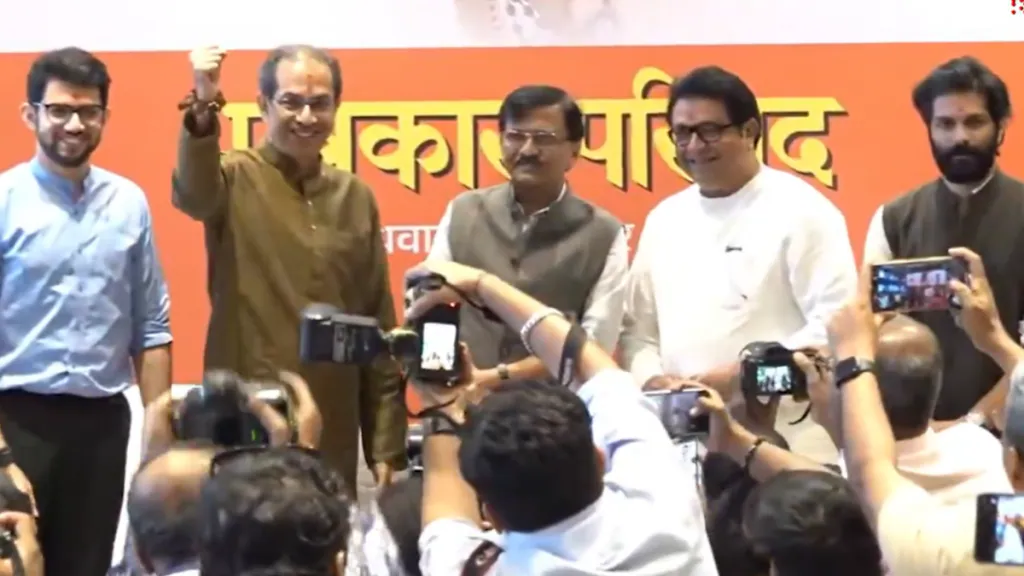
Batenge To Katenge banner for the Mumbai civic polls: After two decades of rivalry, the Thackeray cousins reunite in Mumbai — not just to win an election, but to reclaim the city’s political soul.
In a dramatic turn in Maharashtra politics, Uddhav Thackeray and Raj Thackeray have officially joined hands ahead of the upcoming Mumbai civic elections, ending nearly 20 years of political estrangement.
The reunion, wrapped in the powerful slogan “Batenge To Katenge”, signals a decisive attempt to consolidate the fragmented Marathi vote and challenge the ruling BJP–Shinde Sena alliance in India’s richest municipal corporation — the Brihanmumbai Municipal Corporation (BMC).
The alliance marks one of the most emotionally charged political moments in Mumbai’s recent history, reviving memories of Balasaheb Thackeray’s unified Shiv Sena and reintroducing identity-driven politics at the grassroots civic level.
Why This Alliance Matters in the BMC Battle
The BMC is not just another local body. With an annual budget running into tens of thousands of crores, it controls Mumbai’s infrastructure, housing, roads, public health, and urban planning. Political control over the BMC has long been seen as the gateway to power in Maharashtra.
By coming together, Shiv Sena (UBT) and Maharashtra Navnirman Sena (MNS) aim to reverse the political erosion caused by vote division between Marathi-centric parties — a split that has historically benefited national parties, particularly the BJP.
“Batenge To Katenge”: From Slogan to Strategy
The slogan “Batenge To Katenge” — loosely translating to divide and perish — has been adopted as the ideological glue of the alliance. The message is direct: political fragmentation weakens Marathi representation in Mumbai, while unity can restore influence in civic governance.
Batenge To Katenge banner for the Mumbai civic polls
- Reassert Marathi asmita (pride) in Mumbai’s political discourse
- Stop vote-splitting among regional parties
- Ensure a Marathi mayor in the BMC
- Push back against what they describe as external political dominance in the city
Seat-Sharing and Electoral Mathematics
According to sources, the two parties have broadly agreed on a seat-sharing formula for the BMC elections. Shiv Sena (UBT) is expected to contest approximately 145–150 wards, while MNS will field candidates in around 65–70 wards.
This arrangement reflects the relative organisational strength of the two parties, while allowing MNS to re-enter Mumbai’s civic political space with renewed relevance. The combined vote share could significantly alter the electoral arithmetic, particularly in middle-class Marathi-dominated wards.
A Direct Challenge to BJP–Shinde Sena
The reunion poses a serious challenge to the BJP–Eknath Shinde-led Shiv Sena alliance, which has been eyeing control of the BMC as a symbol of legitimacy after the 2022 Shiv Sena split.
For Uddhav Thackeray, the alliance is a political counteroffensive — aimed at reclaiming the Shiv Sena legacy and exposing what he calls the “hijacking” of Balasaheb Thackeray’s party. For Raj Thackeray, it offers a pathway back into power after years of electoral marginalisation.
Congress and MVA: The Complicated Equation
The Thackeray reunion also complicates the role of the Congress and the wider Mahavikas Aghadi (MVA). While Uddhav’s Sena remains formally aligned with the MVA, Raj Thackeray’s MNS has traditionally kept a distance from national coalitions.
Whether the Congress contests independently, supports the alliance tacitly, or negotiates a broader understanding remains a key political question in the weeks ahead.
Emotional Resonance and Political Risk
Beyond strategy, the alliance carries emotional weight. Images of Uddhav and Raj together resonate deeply with long-time Shiv Sena supporters who witnessed the painful family and political split in the early 2000s.
However, the partnership also carries risks: Batenge To Katenge banner for the Mumbai civic polls
- Ideological differences between Sena (UBT) and MNS
- Leadership egos and cadre-level adjustments
- The challenge of sustaining unity beyond civic polls
What This Means for Mumbai’s Future
If successful, the alliance could redefine Mumbai’s civic governance, prioritising local identity, urban accountability, and decentralised decision-making. It could also set the tone for future state and Lok Sabha elections in Maharashtra.
More importantly, the reunion signals a broader truth of Indian politics — that regional identity, when fractured, loses power, but when unified, can still reshape electoral outcomes.
Conclusion: Batenge To Katenge banner for the Mumbai civic polls
The Uddhav–Raj Thackeray alliance is more than a tactical arrangement for municipal elections. It is a symbolic homecoming, a political recalibration, and a high-stakes gamble aimed at reclaiming Mumbai’s civic narrative.
As the slogan declares — “Batenge To Katenge.” In Mumbai’s upcoming civic polls, the Thackeray cousins are betting that unity, not division, will decide the city’s future.
FOR MORE BLOGS – beyondthepunchlines.com

Author: Team BTP

 Add to favorites