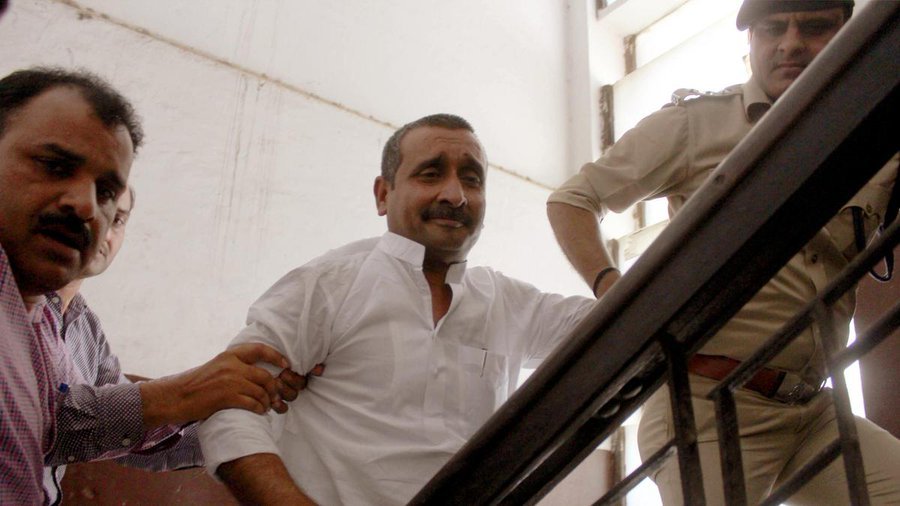
When legal technicalities collide with public outrage, high-profile cases like Kuldeep Singh Sengar’s test the balance between law and social justice.
In a development that has shocked the nation, the Delhi High Court on 23 December 2025 granted conditional bail to Kuldeep Singh Sengar, the convicted former BJP MLA in the 2017 Unnao rape case. The court also suspended his life sentence pending appeal. While the order is legally sound under statutory provisions, it has sparked widespread protests and outrage, highlighting the tension between legal procedure and public expectation of justice.
Background: The Unnao Case Timeline
Kuldeep Singh Sengar, a former BJP MLA from Unnao, Uttar Pradesh, was accused of rape and criminal intimidation in 2017. The case gained national attention due to:
- Allegations of systemic harassment: The survivor and her family faced intimidation, custodial violence, and obstruction in pursuing justice.
- Custodial death of the survivor’s father: In June 2019, the survivor’s father died under suspicious circumstances while in custody, allegedly due to injuries inflicted during attempts to intimidate the family.
- Conviction and life imprisonment: Sengar was convicted in 2019 for aggravated penetrative sexual assault and sentenced to life imprisonment.
Despite the convictions, Sengar’s political influence and the legal appeal process kept the case in the spotlight for years.
Delhi High Court’s Reasoning: Not a Public Servant
The central legal argument for granting bail rested on the interpretation of Sengar’s status as a “public servant”:
- Aggravated Penetrative Sexual Assault Under POCSO Act
- The trial court had convicted Sengar under Section 5(c) of the POCSO Act and Section 376(2)(b) IPC, which carry enhanced punishment when the perpetrator is a public servant.
- The High Court clarified that Sengar, though a former MLA, did not meet the statutory definition of a public servant for the purposes of the aggravated offence, reducing the legal severity of the charge.
- Sentence Suspension Considerations
- Given the reduced classification, Sengar’s actual time served exceeded the minimum sentence required for non-aggravated penetrative sexual assault.
- The High Court exercised discretion to suspend his life sentence pending the appeal, as allowed under Indian law.
Detailed Bail Conditions
The bail order was conditional and aimed at ensuring safety and judicial compliance:
- Personal bond of ₹15 lakh with three sureties of the same amount.
- Mandatory residency in Delhi and weekly reporting to local police.
- Prohibition from approaching within 5 km of the victim’s residence.
- Passport surrender to prevent fleeing the jurisdiction.
- Strict instructions against threatening or intimidating the survivor or her family.
Public and Survivor Response
The Unnao survivor and her family expressed deep distress over the bail decision, calling it a “betrayal of justice”. Public protests erupted outside Delhi courts, emphasizing the emotional and social ramifications of high-profile offenders receiving relief during appeal. The survivor has indicated plans to approach the Supreme Court for urgent intervention.
Legal Expert Analysis
Lawyers and legal commentators note that:
- Suspension of sentence during an appeal is a well-established legal provision, particularly when the convict has served substantial time.
- The case highlights how technical statutory interpretation can impact sentences in high-profile crimes.
- While legally valid, the decision is perceived as morally controversial, reflecting the gap between law and societal expectations.
Broader Implications for Indian Judiciary
This case underscores several critical aspects:
- The importance of precise statutory definitions in high-profile criminal cases.
- The tension between legal technicalities and social justice, particularly in sexual assault cases.
- Need for enhanced protection mechanisms for survivors during appellate proceedings.
- Public perception of justice can be affected significantly when prominent figures are involved, influencing trust in the judicial system.
Conclusion
The Delhi High Court’s bail for Kuldeep Singh Sengar demonstrates the complex interplay of law, procedure, and public sentiment. While the court acted within legal bounds, the decision has provoked widespread debate over victim protection, judicial discretion, and accountability in cases involving influential offenders.
The outcome of Sengar’s appeal will be closely monitored as a litmus test of the judiciary’s capacity to balance legal procedure with societal expectations of justice.
FOR MORE BLOGS – beyondthepunchlines.com

Author: Team BTP

 Add to favorites