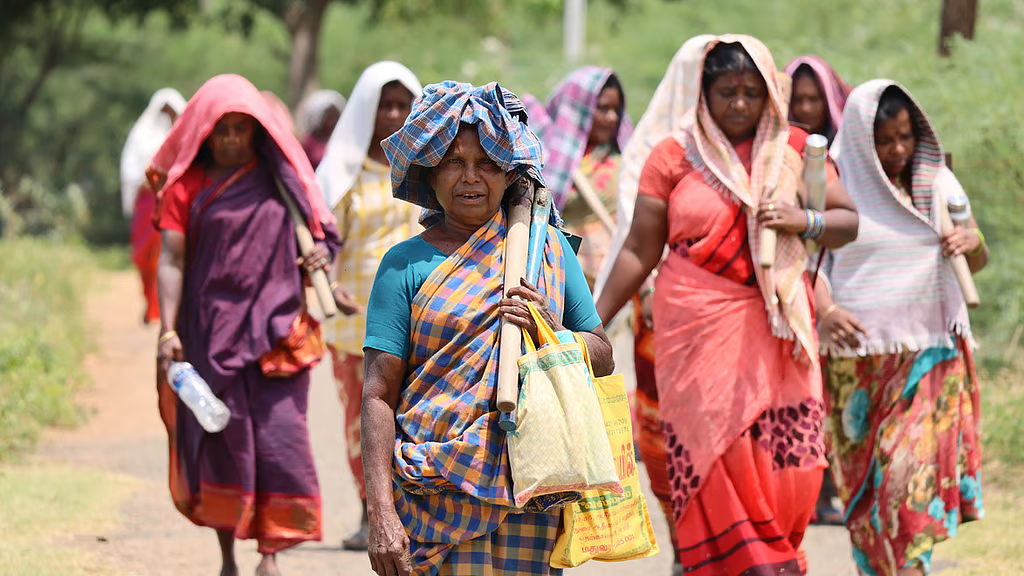
The Union government’s proposal to replace the Mahatma Gandhi National Rural Employment Guarantee Act (MGNREGA) with the new VB–G Ram G Bill has triggered a major political and policy debate across India. For nearly two decades, MGNREGA has been the backbone of rural employment and social security, providing guaranteed wage employment to millions of households.
The introduction of a new framework, coupled with a significant shift in financial responsibility to the states, marks a decisive departure from the existing welfare architecture.
Under the proposed VB–G Ram G Bill, states are expected to shoulder nearly 40 per cent of the total funding, a move that critics argue could weaken rural safety nets in fiscally constrained regions. Supporters of the reform, however, claim that the new model will promote efficiency, accountability, and outcome-based rural development.
What Is the VB–G Ram G Bill?
The VB–G Ram G Bill is being projected as a comprehensive rural livelihood and development programme that aims to merge employment generation with asset creation and skill-based initiatives. Unlike MGNREGA, which guarantees 100 days of wage employment as a legal right, the new bill reportedly focuses on targeted work, productivity-linked wages, and convergence with other rural schemes.
According to officials familiar with the proposal, the government intends to reduce what it views as leakages and inefficiencies under MGNREGA by introducing stricter monitoring, digital tracking, and performance-linked funding mechanisms. The bill is also expected to place greater emphasis on long-term rural infrastructure and village-level economic activities.
Key Differences Between MGNREGA and VB–G Ram G
One of the most contentious aspects of the VB–G Ram G Bill is the dilution of the employment guarantee framework. While MGNREGA provides a statutory right to work, the new bill may move towards a scheme-based approach, potentially limiting legal entitlements.
Another major shift lies in the funding pattern. Under MGNREGA, the Centre bears the bulk of the cost, particularly for wages. In contrast, the VB–G Ram G Bill proposes a 60:40 funding split, significantly increasing the financial burden on states. This change has raised concerns about uneven implementation, especially in poorer states with limited fiscal capacity.
States Push Back on Funding Burden
Several state governments have expressed strong reservations about the proposed funding structure. Opposition-ruled states, in particular, argue that transferring 40 per cent of the cost to states without commensurate revenue support undermines cooperative federalism.
Chief ministers and finance ministers from multiple states have warned that the new bill could force states to either scale back rural employment programmes or divert funds from other critical sectors such as health and education. They have also highlighted pending dues under MGNREGA, questioning the Centre’s ability to ensure timely payments under the new framework.
Impact on Rural Employment and Migration
Experts caution that any dilution of guaranteed employment could have serious consequences for rural livelihoods. MGNREGA has historically acted as a buffer during economic shocks, including droughts, agrarian distress, and the COVID-19 pandemic.
If the VB–G Ram G Bill fails to provide similar employment assurance, rural workers may be pushed towards seasonal migration in search of work. Labour economists warn that this could exacerbate urban stress and deepen rural-urban inequalities.
Government’s Rationale and Reform Pitch
The Centre has defended the proposed overhaul by arguing that MGNREGA has outlived its original purpose and needs reform to align with contemporary development goals. Officials claim that the VB–G Ram G Bill will focus on quality assets, skill development, and measurable outcomes rather than merely providing wage employment.
The government also maintains that greater state participation in funding will encourage ownership, innovation, and better implementation at the grassroots level.
Political and Policy Implications
The proposed replacement of MGNREGA is likely to become a major flashpoint in Parliament and upcoming state elections. Opposition parties have accused the Centre of weakening a landmark social welfare law and shifting responsibility onto states to manage fiscal pressures.
Policy analysts believe that the success or failure of the VB–G Ram G Bill will depend on how effectively it balances fiscal prudence with social protection. Without adequate safeguards, the reform risks eroding one of India’s most significant anti-poverty programmes.
The Centre’s VB–G Ram G Bill represents a fundamental rethinking of rural employment policy in India. While the government argues that the reform will bring efficiency and development-oriented outcomes, the proposed funding shift and dilution of guaranteed employment have raised serious concerns.
As Parliament debates the bill, the challenge will be to ensure that fiscal restructuring does not come at the cost of rural livelihoods and social security. The future of millions of rural workers now hinges on whether the new framework can truly replace, rather than weaken, the protections offered by MGNREGA.
FOR MORE BLOGS – beyondthepunchlines.com

Author: Team BTP

 Add to favorites