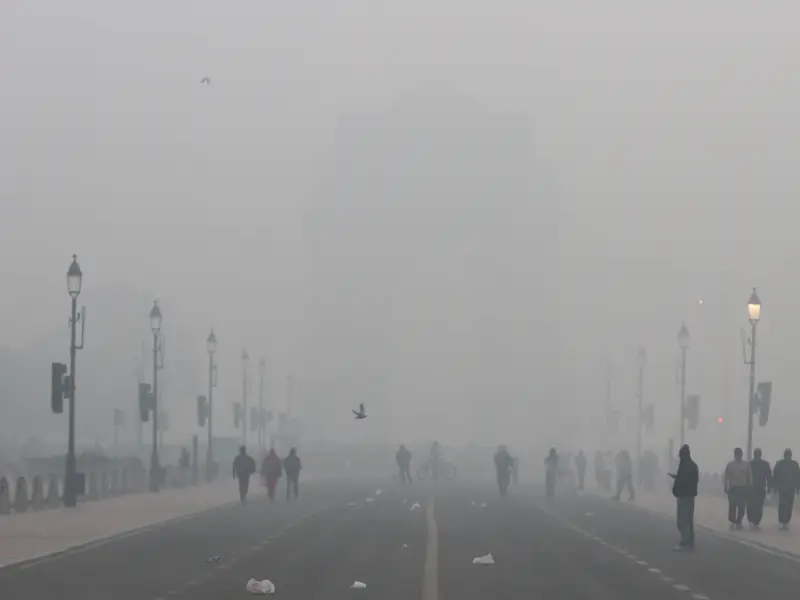
Delhi air pollution crisis – When breathing itself becomes risky, Delhi is forced to shut classrooms and construction sites to protect its people.
A City Under a Grey Blanket
Delhi woke up on December 14, 2025, under a thick, toxic haze as air pollution levels surged to severe-plus and hazardous categories across the National Capital Region (NCR). Several monitoring stations recorded an Air Quality Index (AQI) well above 450, with some touching the 500 mark, indicating conditions dangerous even for healthy individuals.
Low wind speed, falling temperatures, and a temperature inversion trapped pollutants close to the ground, turning the city into a gas chamber. Visibility dropped sharply, daily routines were disrupted, and hospitals reported a spike in respiratory complaints, eye irritation, and breathing difficulties.
Schools Shift to Online and Hybrid Classes
With children among the most vulnerable to air pollution, authorities directed schools across Delhi, Noida, and Ghaziabad to suspend full physical attendance. Many schools moved to online classes, while others adopted a hybrid model, depending on infrastructure and class levels.
Several districts allowed complete online learning for primary classes, while senior students were given flexibility to attend digitally. Parents welcomed the move as a necessary health safeguard, even as concerns grew over learning disruption and screen fatigue.
Construction and Demolition Work Banned
As pollution crossed emergency thresholds, the government activated Stage IV of the Graded Response Action Plan (GRAP). One of the most stringent measures under GRAP IV is a complete ban on non-essential construction and demolition activities across Delhi-NCR.
Construction dust is a major contributor to particulate matter (PM2.5 and PM10), and halting such activity is seen as an immediate way to prevent further deterioration of air quality. Enforcement teams were deployed to ensure compliance, with penalties for violations.
Other Emergency Restrictions in Place: Delhi air pollution crisis
Along with school closures and construction bans, several additional curbs were enforced to reduce emissions:
- Restrictions on polluting vehicles and tighter checks on diesel usage
- Temporary shutdown of high-emission industrial units
- Advisory for work-from-home wherever feasible
- Strong health warnings for children, elderly, and those with respiratory illnesses
Public events were discouraged, and residents were advised to limit outdoor activities unless absolutely necessary.
Why Delhi air pollution crisis Turns Toxic Every Winter
The recurring winter pollution crisis in Delhi is driven by multiple overlapping factors:
- Crop residue burning in neighbouring states
- Vehicular emissions from millions of vehicles
- Construction dust and industrial pollution
- Firecrackers and domestic fuel usage
- Unfavourable meteorological conditions that trap pollutants
Experts warn that emergency measures provide temporary relief but do not address the structural causes of the crisis.
Health Impact and Global Attention
The toxic smog has once again drawn international attention, with foreign missions issuing advisories for their citizens in Delhi-NCR. Health experts cautioned that prolonged exposure can reduce lung capacity, worsen asthma, trigger heart conditions, and increase long-term cancer risk.
Doctors recommend staying indoors, using air purifiers if available, wearing masks outdoors, and seeking medical help at the first sign of breathing distress.
Conclusion: Delhi air pollution crisis
Delhi’s shift to online classes and the ban on construction work underline the gravity of its air pollution emergency. While such steps are necessary to prevent immediate harm, they also highlight a deeper failure to implement long-term pollution control solutions.
FOR MORE BLOGS – beyondthepunchlines.com

Author: Team BTP

 Add to favorites