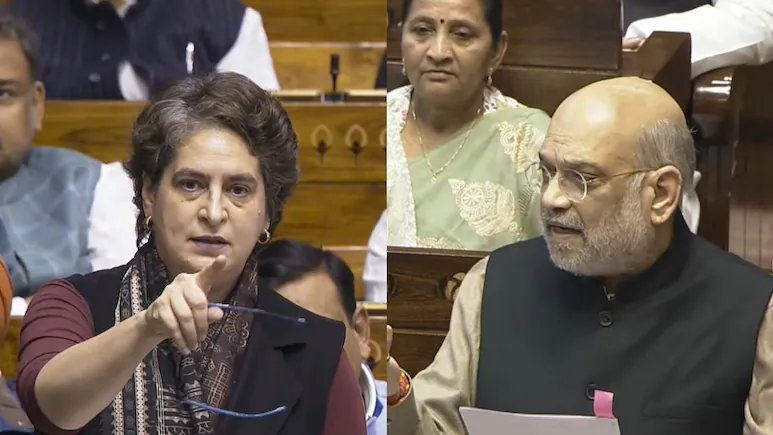
Vande Mataram debate: When a 150-year-old national song becomes the centre of Parliament’s hottest political fight.
The Winter Session of Parliament witnessed one of its most charged debates on December 9, 2025, when Union Home Minister Amit Shah forcefully countered Priyanka Gandhi Vadra’s remarks on the ongoing Vande Mataram discussions. What began as a cultural commemoration of 150 years of the iconic national song erupted into a fiery political showdown, with Shah launching a sharp attack on Congress leadership—past and present—while rejecting any claims of electoral motives behind the government’s renewed focus on Vande Mataram.
Priyanka Gandhi’s Charge: A Bengal Election Gambit?
Priyanka Gandhi Vadra accused the ruling BJP of deliberately pushing the Vande Mataram debate to influence the 2026 West Bengal elections. According to her, the timing and intensity of the discussion signaled an attempt to weaponize cultural sentiment for political gain. She even invoked historical documents, including communications linked to Subhas Chandra Bose, to argue that the government’s narrative lacked nuance.
Her remarks immediately drew strong reaction from the treasury benches, with Amit Shah rising to deliver a pointed rebuttal.
Amit Shah Hits Back: “Do Not Insult Vande Mataram by Linking It to Politics”
Amit Shah dismissed Priyanka Gandhi’s claims as “unfortunate” and “misplaced,” asserting that the Vande Mataram debate has no connection whatsoever to the West Bengal polls. He accused the Congress of habitually reducing national symbols to political talking points, thereby distorting their historical value.
Shah argued that Vande Mataram debatethe is far beyond electoral mathematics—it is a symbol of India’s cultural and civilizational identity, and commemorating its 150-year legacy is a national duty, not a political strategy.
The Nehru–Indira Question: Shah’s Historical Broadsides
In one of the most controversial moments of the session, Amit Shah took direct aim at former Congress Prime Ministers Jawaharlal Nehru and Indira Gandhi. Quoting historical accounts, he accused Nehru of restricting Vande Mataram to just two stanzas—a decision Shah said was driven by appeasement politics during a delicate phase of post-Independence nation-building.
He went further and alleged that during Indira Gandhi’s Emergency era, people who sang or promoted Vande Mataram were “suppressed” or discouraged. Shah framed these events as part of a long pattern within Congress of sidelining cultural heritage to preserve political narratives.
Opposition Pushback: Congress Says BJP “Rewriting History”
Congress leaders, including Mallikarjun Kharge, immediately hit back, accusing Amit Shah and Prime Minister Modi of cherry-picking history and weaponizing nationalism. They argued that previous Congress governments did not undermine Vande Mataram but sought to maintain harmony during sensitive phases of India’s communal and political journey.
According to the opposition, the BJP is attempting to polarize the atmosphere by placing historical decisions out of context and framing them as acts of betrayal.
A Larger Cultural Battle: What This Debate Really Signals
Beyond the heated exchanges, the Vande Mataram debate clash symbolises a deeper ideological confrontation that continues to define Indian politics. For the BJP, reclaiming cultural symbols forms the core of its nation-building narrative. For Congress, the challenge lies in countering this narrative without appearing dismissive of national heritage.
The 150-year commemoration of Vande Mataram has thus become more than a cultural event—it has evolved into a referendum on narratives of nationalism, secularism, and historical accountability.
Why Vande Mataram Still Matters: Vande Mataram debate
Vande Mataram is more than a song. It was the emotional fuel of India’s freedom struggle. Revolutionary groups adopted it as a cry of resistance, and generations of Indians saw it as the sound of self-determination.
Its significance today lies not just in its melody, but in its ability to spark conversations about identity, unity, and national memory.
Conclusion: Vande Mataram debate
The clash between Amit Shah and Priyanka Gandhi over Vande Mataram has reopened old ideological wounds and highlighted how deeply cultural symbols remain entwined with political power. As Parliament continues to debate the legacy of the national song, the larger question persists: Should symbols of national pride be elevated above political contestation, or are they inevitably destined to become battlegrounds in India’s ever-evolving democracy?
One thing is certain—Vande Mataram debate, even 150 years later, still has the power to ignite the nation’s most passionate political debates.
FOR MORE BLOGS – beyondthepunchlines.com

Author: Team BTP

 Add to favorites