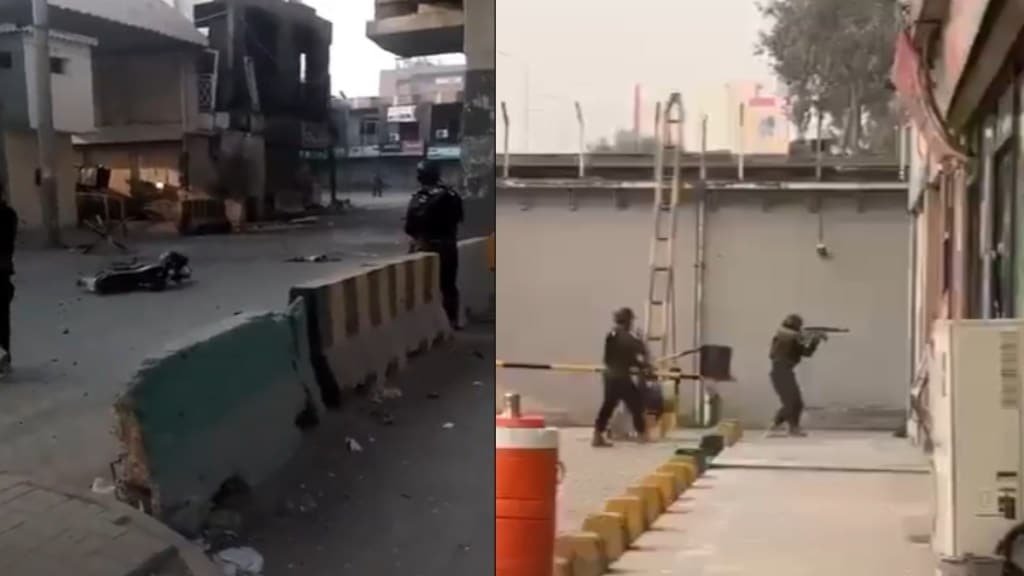
When the gates of a paramilitary force in Pakistan fall silent under gunfire, it’s not just an attack—it’s a question mark on Pakistan’s crumbling internal security.
A Day of Chaos in Peshawar
On 24 November 2025, a paramilitary force in Pakistan woke up to a brazen and meticulously planned assault on one of its most sensitive security establishments—the Frontier Constabulary (FC) headquarters in Peshawar. What began as a routine morning was violently shattered when two suicide bombers arrived at the compound’s entrance. The first bomber detonated his explosive vest at the main gate, ripping through the outer security layer and sending shockwaves across the busy neighbourhood.
Within minutes, a second bomber infiltrated deeper into the premises and detonated inside the compound, causing massive structural damage. The explosions were immediately followed by sustained gunfire as multiple armed militants stormed the headquarters, indicating a high level of coordination and tactical planning.
Eyewitnesses described scenes of panic—smoke rising over the cantonment zone, sirens blaring, and terrified residents rushing indoors as gunfire echoed through the streets. The FC headquarters, located near densely populated civilian areas and military facilities, quickly became the centre of a full-blown urban battle.
paramilitary force in Pakistan: Casualties, Damage, and Emergency Response
According to initial police reports, at least three people were killed, including security personnel caught in the first blast. Dozens more are believed to be injured, though the exact toll is still being assessed. Emergency teams struggled to enter the premises immediately due to the intensity of firing.
Security forces, including elite police commandos and Pakistan Army rapid response units, swiftly cordoned off the entire area. All roads leading to the FC headquarters were blocked as snipers took positions on rooftops, anticipating more attackers inside.
Authorities have warned that the situation remains fluid, with the possibility of additional militants still hiding within the compound. A controlled, room-by-room clearance operation is underway—a process that could take several hours.
FC Headquarters: A Strategic and Symbolic Hit
The Frontier Constabulary plays a crucial role in Pakistan’s internal security network. It handles:
- Urban counter-terrorism duties
- Protection of key installations
- Assistance to police during high-risk operations
- Maintaining order in border regions and sensitive conflict zones
Attacking the FC headquarters is not just an operational hit—it is a symbolic strike aimed at shaking public confidence in Pakistan’s state machinery. The headquarters’ proximity to Peshawar Cantonment further highlights the audacity of the attackers.
Local media confirmed that two extremely powerful bombs were used to breach the gate, indicating access to high-grade explosives typically associated with organised militant groups.
A Resurgence of Militant Activity: paramilitary force in Pakistan
Pakistan has seen a disturbing uptick in attacks over the last two years, especially in Khyber Pakhtunkhwa. Militants have increasingly targeted police stations, military convoys, and intelligence offices.
The Peshawar attack raises troubling questions:
- Are militant networks regaining territorial and operational strength?
- How did attackers bypass multiple layers of surveillance and intelligence monitoring?
- Are hostile groups exploiting political instability and economic distress?
Security analysts argue that Pakistan may be experiencing the consequences of a fragmented counter-terror strategy and weakening state control in conflict-prone regions.
Government and Military Reaction: paramilitary force in Pakistan
A high-level security meeting is expected in Islamabad as the attack is being classified as a major national security incident. Intelligence agencies are examining whether the attackers had inside help or exploited recent administrative lapses.
Unofficial sources indicate that authorities are investigating potential links to banned outfits operating in and around the Pakistan-Afghanistan border. However, until a group claims responsibility, speculation continues.
Pakistan’s political leadership is under immense pressure to reassure the public and demonstrate that militant groups cannot strike at will.
International and Regional Implications: paramilitary force in Pakistan
Peshawar lies close to one of the most volatile geopolitical corridors in South Asia. Any major terror attack here has ripple effects that extend beyond Pakistan’s borders.
International observers are closely monitoring the situation, especially countries involved in regional security partnerships. A successful high-profile attack on a paramilitary headquarters signals that South Asia’s militant landscape remains dangerously active.
Conclusion: A Nation on Edge, A System Under Strain
The attack on the FC headquarters is a chilling reminder that Pakistan’s internal security structure is under immense strain. Whether this incident represents a renewed wave of terrorism or a continuation of long-standing extremist threats, it underscores a brutal truth: Pakistan’s cities are far from safe.
The coming days will reveal more details—who planned the attack, how it was executed, and what it means for Pakistan’s already fragile stability. For now, the nation watches, wounded but wary, hoping the worst is over.
FOR MORE BLOGS – beyondthepunchlines.com

Author: Team BTP

 Add to favorites