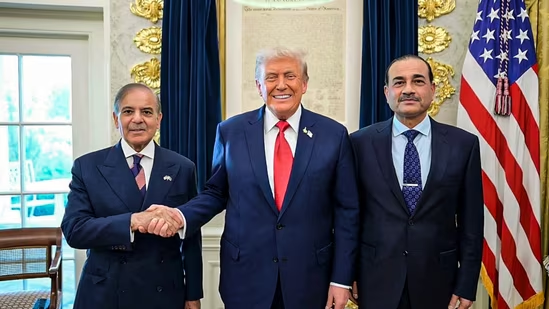
Pakistan’s Reaction to Trump: Trump’s claim rattled the world, but Pakistan’s firm denial reinforces that credibility, not rhetoric, remains the true deterrent in nuclear politics.”
In an unexpected twist of global diplomacy, Pakistan has issued a strong rebuttal to former US President Donald Trump’s explosive claim that the South Asian nation has resumed nuclear weapons testing. The controversy erupted after Trump’s interview aired on November 4, 2025, on CBS’s 60 Minutes, where he alleged that Pakistan, along with Russia and China, had been secretly conducting nuclear tests.
The remarks have since sent ripples across the international community, sparking renewed discussions on nuclear non-proliferation, global security, and strategic stability in South Asia. Trump’s statement — though lacking supporting evidence — has reignited fears of a potential return to the nuclear testing era of the Cold War.
Pakistan’s Strong and Swift Rebuttal
Within hours of Trump’s comments, Pakistan’s Foreign Office dismissed the allegations as “baseless, misleading, and devoid of factual accuracy.” In a statement carried by major global media outlets, a senior Pakistani official declared, “Pakistan was not the first to carry out nuclear tests, and it will not be the first to resume them.” The official reaffirmed that Islamabad remains committed to its voluntary moratorium on nuclear testing in place since May 1998, when it conducted its last series of tests at Chagai.
The statement underscored Pakistan’s longstanding commitment to responsible nuclear stewardship, asserting that its nuclear doctrine is purely defensive and aimed at preserving regional stability and strategic deterrence. The Foreign Office also reiterated Pakistan’s partial alignment with the Comprehensive Nuclear-Test-Ban Treaty (CTBT), noting that while it has yet to sign the treaty, it supports its broader objectives.
The Context Behind Trump’s Claim: Pakistan’s Reaction to Trump
Trump’s comments came amid renewed debates in Washington about whether the United States should resume nuclear testing to modernize its arsenal. During the interview, Trump stated, “Russia’s testing, China’s testing — and certainly Pakistan’s testing,” suggesting that these nations were secretly advancing their nuclear programs. The former president claimed such activities justified America’s need to “stay competitive.”
However, nuclear watchdogs and independent analysts have found no seismic or satellite evidence of recent nuclear detonations from Pakistan. Experts from the International Atomic Energy Agency (IAEA) and the Bulletin of the Atomic Scientists have confirmed that no known test signatures — such as ground shockwaves or radiation leaks — have been detected in the region since 1998.
Expert and Global Reactions: Pakistan’s Reaction to Trump
The global reaction has been swift and divided. In Washington, national security analysts accused Trump of reckless rhetoric, saying his claim could destabilize delicate diplomatic relationships with nuclear-armed nations.
Former US officials, including those from the State Department and National Security Council, emphasized that any suggestion of resumed nuclear testing in South Asia is extremely sensitive and could fuel an arms race. One official commented, “Words from a former US president carry weight — and even unverified claims can trigger real-world consequences.”
Meanwhile, Islamabad-based analysts noted that Pakistan’s restraint since 1998 has been one of its most consistent strategic policies. Defence commentator Lt. Gen. (Retd.) Talat Masood stated, “Trump’s remarks appear politically motivated. Pakistan has every reason to avoid testing because it seeks legitimacy as a responsible nuclear state.”
Historical Background: Pakistan’s Nuclear Doctrine
Pakistan’s nuclear history dates back to the 1970s, following India’s first nuclear test in 1974. The program accelerated in response to perceived security threats, culminating in the Chagai-I tests of 1998, which followed India’s Pokhran-II detonations earlier that month. Since then, Islamabad has maintained a policy of minimum credible deterrence, focusing on improving delivery systems and command structures rather than explosive testing.
The 1998 Chagai tests cemented Pakistan’s position as the world’s seventh nuclear-armed state. However, Islamabad has repeatedly emphasized that its nuclear capability is meant as a deterrent, not a tool for aggression. The commitment to “not be the first to resume nuclear testing” has been part of official policy for over two decades.
Broader Implications for Global Non-Proliferation
Trump’s allegations have reignited global fears over the erosion of arms control agreements and the weakening of the Comprehensive Nuclear-Test-Ban Treaty (CTBT) framework. Analysts warn that if major powers such as the US, Russia, or China resume nuclear testing, it could lead other states — including Pakistan and India — to follow suit, undoing decades of diplomatic progress.
International think tanks have also noted that the timing of Trump’s comments coincides with ongoing US-China tensions and the Ukraine-Russia war, where nuclear rhetoric has once again entered mainstream discourse. The danger, experts caution, lies not only in actual tests but in political normalization of nuclear brinkmanship.
India’s Silence and Regional Reactions
While India has refrained from officially commenting on Trump’s remarks, security experts in New Delhi are closely monitoring developments. Any perception of renewed Pakistani testing could influence India’s defense modernization and deterrence policies. Regional analysts believe both countries may face international pressure to reaffirm their testing moratoria to maintain South Asia’s fragile stability.
China, meanwhile, has also dismissed Trump’s claim, calling it “unsubstantiated and politically motivated.” The Chinese Foreign Ministry accused the former US leader of “sowing distrust” and “provoking global insecurity.”
The Diplomatic Fallout: Pakistan’s Reaction to Trump
The Pakistani government has signaled that it will raise the issue diplomatically to prevent the spread of misinformation. Islamabad is expected to brief the United Nations Security Council (UNSC) and the IAEA to reinforce its commitment to nuclear restraint.
For Pakistan, maintaining credibility in global nuclear discourse is critical, not just for security but also for its international reputation and economic partnerships, especially as it continues to seek foreign investment and IMF cooperation.
Conclusion: Pakistan’s Reaction to Trump
Donald Trump’s claim has once again demonstrated how political rhetoric can influence international relations and security discourse. Pakistan’s robust and evidence-based rebuttal highlights its determination to defend its position as a responsible nuclear power committed to peace and deterrence.
While Trump’s statement may have ignited global anxiety, Pakistan’s consistent message — that it was not and will not be the first to resume nuclear testing — serves as a stabilizing reassurance in an otherwise volatile world.
FOR MORE BLOGS – beyondthepunchlines.com

Author: Team BTP

 Add to favorites