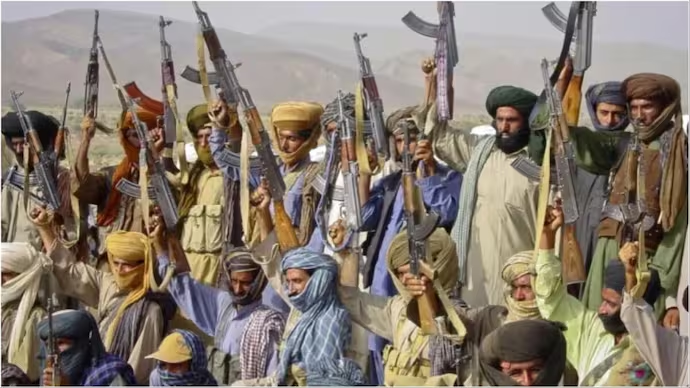
The biggest Baloch attack in decades has marked a significant escalation in Pakistan’s long-running insurgency in Balochistan, drawing international attention due to its scale and strategic implications. The coordinated assaults carried out by militants linked to the Balochistan Liberation Army targeted security forces and critical infrastructure across multiple districts, resulting in heavy casualties.
Beyond the immediate loss of life, the incident serves as a Balochistan attack wake-up call for US China, underscoring how regional instability now threatens broader geopolitical and economic interests.
Escalating Violence in Balochistan
The recent wave of attacks represents one of the most serious episodes of Balochistan violence escalation in years. Militants executed well-planned operations, demonstrating improved coordination and operational capability.
According to the Baloch insurgency Pakistan latest news, security forces launched large-scale counter-operations in response, claiming to have neutralized several attackers. However, the scale of the violence suggests that insurgent networks remain deeply entrenched.
The Balochistan Liberation Army attack highlights the evolving nature of the conflict, which has shifted from sporadic strikes to large coordinated offensives.
Strategic Importance of Balochistan
Balochistan occupies a crucial geopolitical position. It borders Iran and Afghanistan and holds vast reserves of natural gas, minerals, and coastal access. The province is also home to Gwadar Port, a key node in the China-Pakistan Economic Corridor security framework.
CPEC is central to China’s Belt and Road Initiative, aimed at creating a direct trade route between western China and global markets. Stability in Balochistan is therefore essential for the success of these projects.
Continued unrest poses serious CPEC security threats, raising concerns in Beijing about long-term investment risks.
Roots of the Insurgency
The insurgency in Balochistan Pakistan is driven by decades of political marginalization, economic neglect, and disputes over control of natural resources. Many local communities argue that revenues from gas and mineral extraction benefit the federal government while leaving the province underdeveloped.
Key grievances include:
- Limited local autonomy
- Unequal resource distribution
- Inadequate infrastructure and employment opportunities
This persistent dissatisfaction has fueled cycles of resistance, contributing to the latest escalation.
Implications for China
China has increasingly become a target of militant groups due to its extensive presence in the region. Past incidents involving attacks on Chinese projects in Pakistan have already forced Beijing to push for stronger security measures.
The scale of the latest assault intensifies Chinese concerns about the safety of:
- Infrastructure investments
- Chinese personnel
- Trade routes linked to CPEC
If instability continues, China may be compelled to reassess project timelines, security arrangements, and future investments in Pakistan.
Implications for the United States
For Washington, the renewed violence raises fresh US concerns over Baloch conflict and its potential spillover effects. The United States has long supported Pakistan’s counterterrorism efforts, viewing stability as essential for regional security.
An emboldened insurgency could:
- Undermine Pakistan’s internal stability
- Create new militant safe havens
- Complicate security dynamics near Afghanistan and Iran
These risks make Balochistan increasingly relevant in US strategic calculations.
Pakistan’s Growing Internal Security Challenge
The attacks have once again highlighted Pakistan’s broader internal security crisis. Despite years of military operations, insurgent groups continue to demonstrate resilience and adaptability.
Security analysts argue that relying solely on force has failed to address the political and economic drivers of the conflict. Without meaningful dialogue and development that directly benefits local populations, violence is likely to persist.
A Broader Geopolitical Signal
The biggest Baloch attack in decades represents more than a domestic security issue. It reflects a convergence of:
- Local grievances
- Militant resurgence
- Global economic interests
As Balochistan becomes increasingly central to international trade and strategic competition, instability there has global consequences.
Conclusion
The recent escalation in Balochistan serves as a critical warning for both regional and global powers.
The biggest Baloch attack in decades has exposed persistent governance challenges, rising insurgent strength, and serious threats to major international investments.
For China, it jeopardizes flagship infrastructure projects under CPEC.
For the United States, it raises alarms about regional security and counterterrorism risks.
Unless Pakistan undertakes comprehensive political and economic reforms to address the root causes of the insurgency, the cycle of violence is likely to continue — with increasing implications for global stability.
FOR MORE BLOGS – beyondthepunchlines.com

Author: Team BTP

 Add to favorites