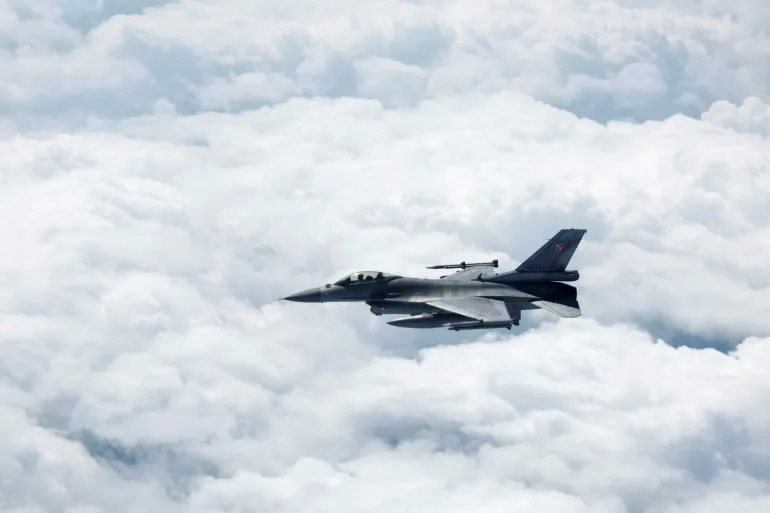
Polish jets intercept Russian plane: A tense mid-air encounter over the Baltic Sea underscores how close NATO–Russia friction now flies.
What Happened: Polish jets intercept Russian plane
Polish Air Force fighter jets were scrambled to intercept and visually identify a Russian military reconnaissance aircraft detected flying close to Poland’s airspace over the Baltic Sea. According to Poland’s Operational Command, the aircraft was tracked, approached, and escorted away from the area of responsibility without breaching Poland’s sovereign airspace. The incident occurred during the Christmas period, a time when regional militaries typically maintain heightened readiness due to increased cross-border activity.
Official Response from Poland: Polish jets intercept Russian plane
Polish authorities stated that the interception was a standard air-policing operation conducted under NATO protocols. The jets identified the aircraft and ensured it altered course away from Polish-controlled airspace. Military officials emphasized that there was no immediate threat to national security, but the situation was monitored closely by radar and air-defense systems.
Poland also temporarily restricted civilian air traffic in parts of northeastern airspace after detecting unidentified objects entering from the direction of Belarus. These objects were later assessed as likely balloons, but the episode added to the overall sense of heightened alert.
Why Russian Reconnaissance Flights Matter
Russian reconnaissance aircraft are designed to collect intelligence on radar systems, air-defense responses, and military readiness. Flying close to NATO airspace allows Moscow to test reaction times and surveillance coverage without formally violating international law. While such flights are not new, their frequency has increased since the war in Ukraine, particularly over the Baltic Sea region.
NATO Context and Regional Tensions
Poland sits on NATO’s eastern flank, bordering Russia’s Kaliningrad enclave and Belarus, a close Russian ally. As a result, it plays a critical role in NATO’s air-policing mission. Interceptions like this one are routine but symbolically significant, demonstrating the alliance’s readiness to defend member states’ airspace while avoiding direct escalation.
NATO officials have repeatedly stated that these encounters are defensive in nature, aimed at deterrence rather than confrontation. However, analysts warn that repeated close encounters raise the risk of miscalculation, especially during periods of high geopolitical tension.
Pattern of Similar Incidents
This interception follows a series of recent incidents involving Russian military aircraft operating near the airspace of NATO members, including the Baltic states and the United Kingdom. Most end without escalation, but each adds to the growing record of military brinkmanship in Europe’s northern and eastern corridors.
Bigger Picture: Polish jets intercept Russian plane
While no airspace violation occurred, the incident highlights how fragile security dynamics have become in Europe. Routine military maneuvers now carry outsized political and strategic significance. For Poland and NATO, swift interception signals vigilance and deterrence. For Russia, reconnaissance flights remain a way to assert presence and gather intelligence without crossing red lines.
Conclusion: Polish jets intercept Russian plane
The interception of a Russian reconnaissance plane by Polish jets may have ended without incident, but it serves as a reminder that Europe’s skies remain crowded with geopolitical tension. As NATO–Russia relations remain strained, such encounters are likely to continue, keeping the region on constant alert.
FOR MORE BLOG – beyondthepunchlines.com

Author: Team BTP

 Add to favorites